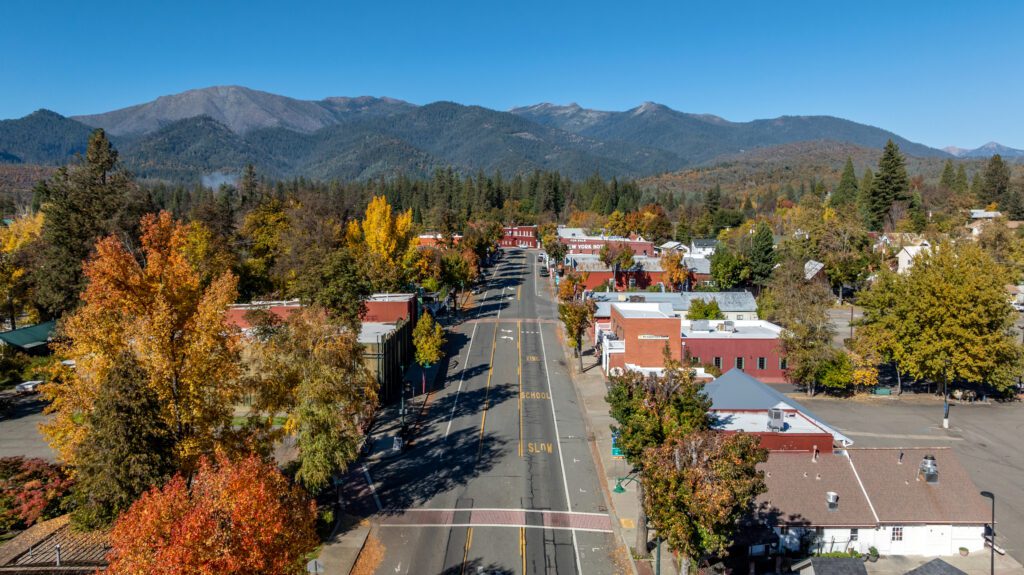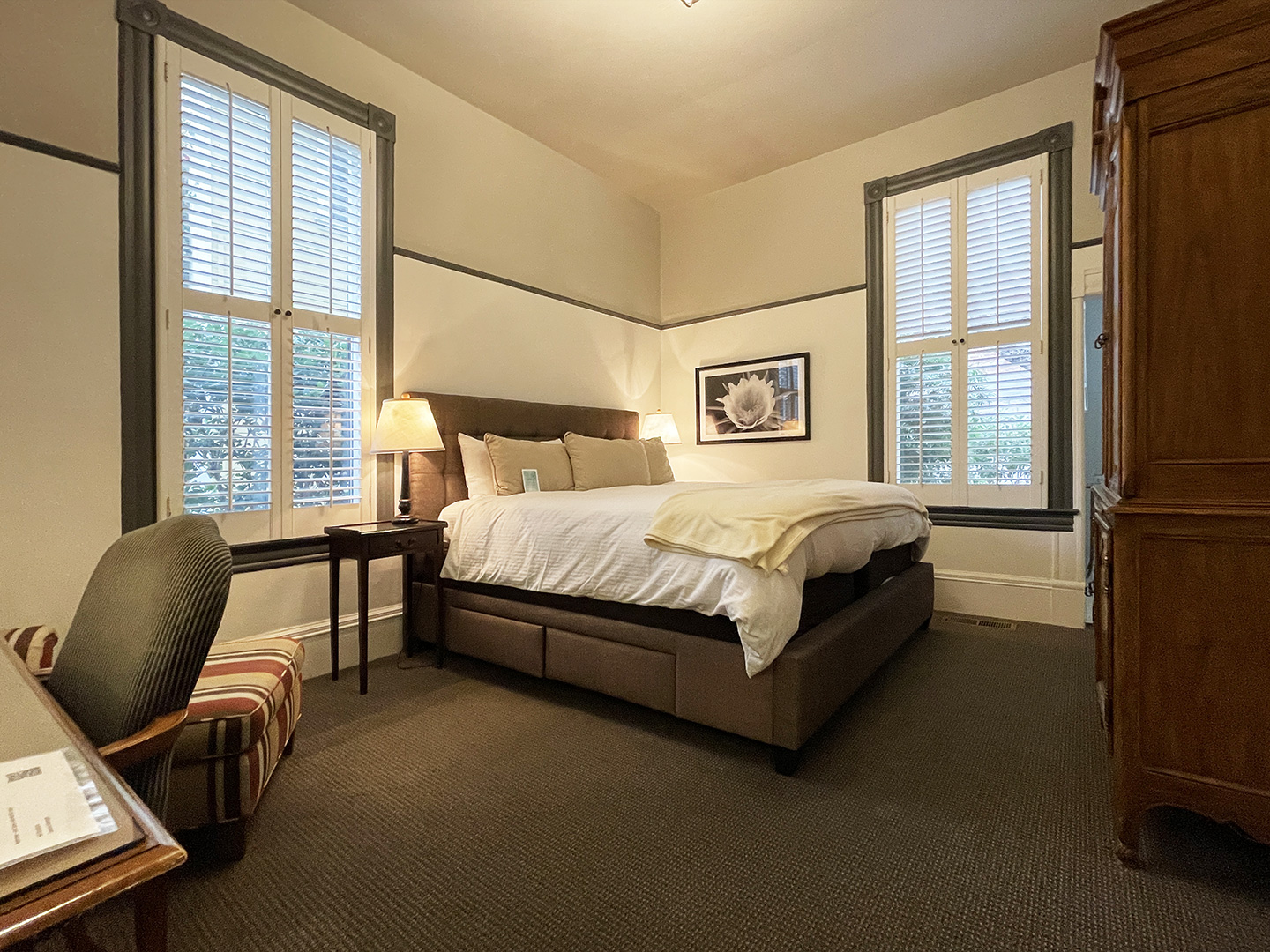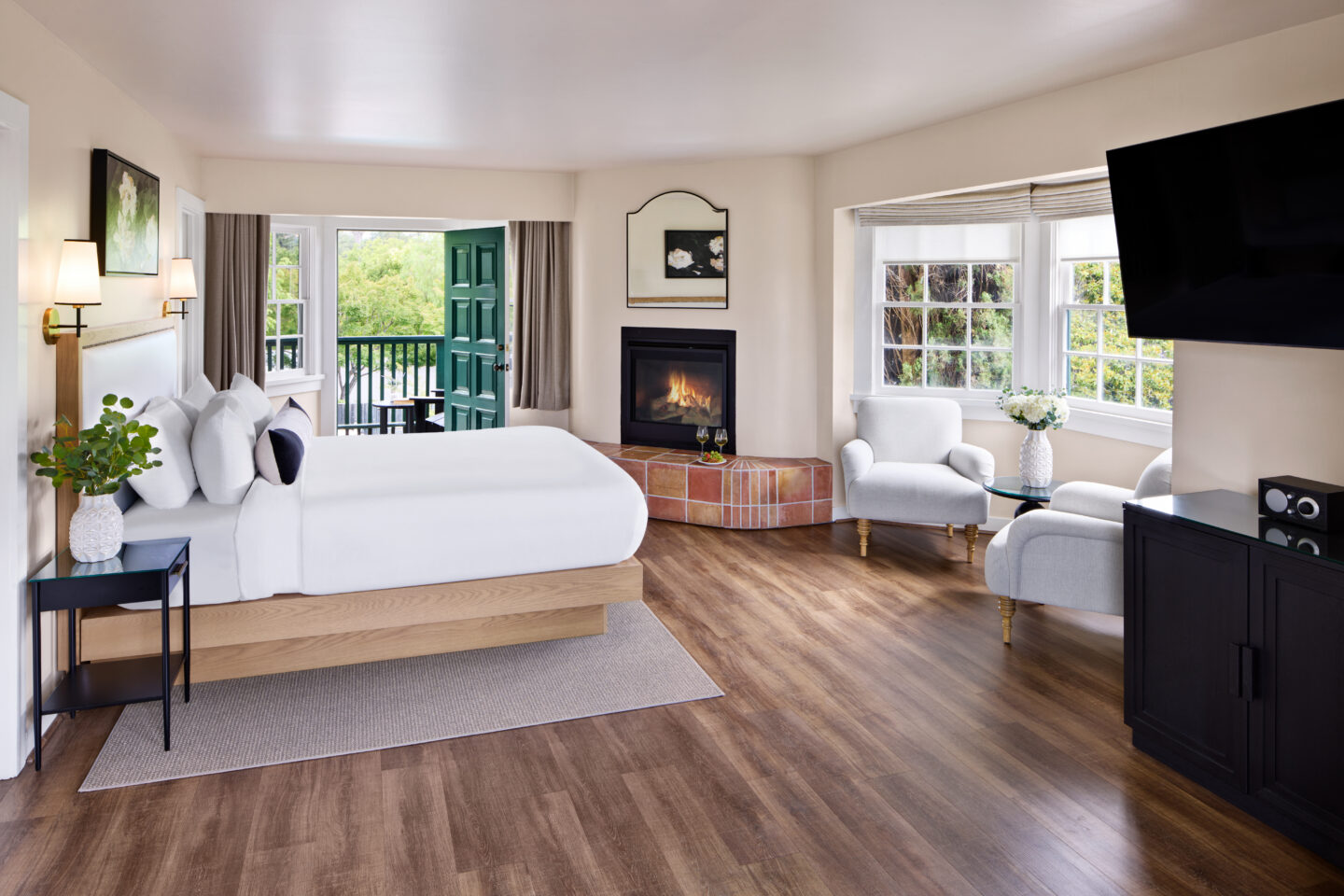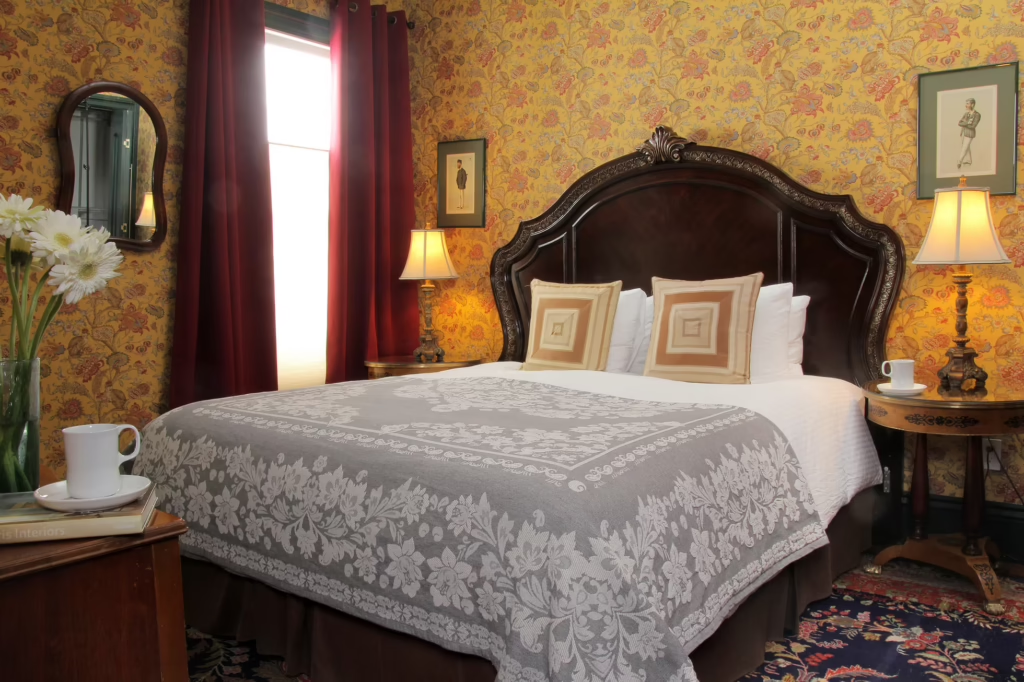
Best Places for Fall Color in California

Autumn in California is a study in contrasts. While the Golden State is famous for endless summers, fall ushers in unexpectedly dazzling displays of color across a range of landscapes. Golden aspens glow in the high Sierra, fiery dogwoods and maples speckle evergreen forests, and rows of wine country vines turn to ribbons of crimson and gold. 

Thanks to the state’s dramatic range of elevations and climates, the seasonal spectacle doesn’t happen all at once. It unfolds like a slow-moving wave over a few months. The show starts in the high-elevation peaks in September, cascades down through the mountains in October, and lingers in wine country and lower elevations well into November and even early December.

Here are some of our favorite California destinations for an autumn road trip.

Highway 108 going over Sonora Pass

Sonora Pass

Highway 108 over Sonora Pass delivers one of the most breathtaking routes through the Sierra Nevada in the fall. Here, dense groves of quaking aspens ignite in an explosion of yellow and orange, standing out in sharp contrast against dark green conifers, granite peaks, and intensely blue Sierra skies. 

The highway winds through the Stanislaus National Forest offering travelers a succession of scenic rewards. Essential stops include the tranquil shores of Pinecrest Lake, the dizzying drop of Donnell Vista, and the expansive golden reaches of Sardine and Leavitt Meadows. Because the highway climbs rapidly in elevation, the foliage progresses in stages. The highest groves put on their show first, followed by a slow cascade of color down the mountainside. 

The display typically begins in late September and peaks from early to mid-October. However, early high-country snow can bring the season to a sudden end, making it essential to check road closures and weather conditions before heading out.

Where to Stay

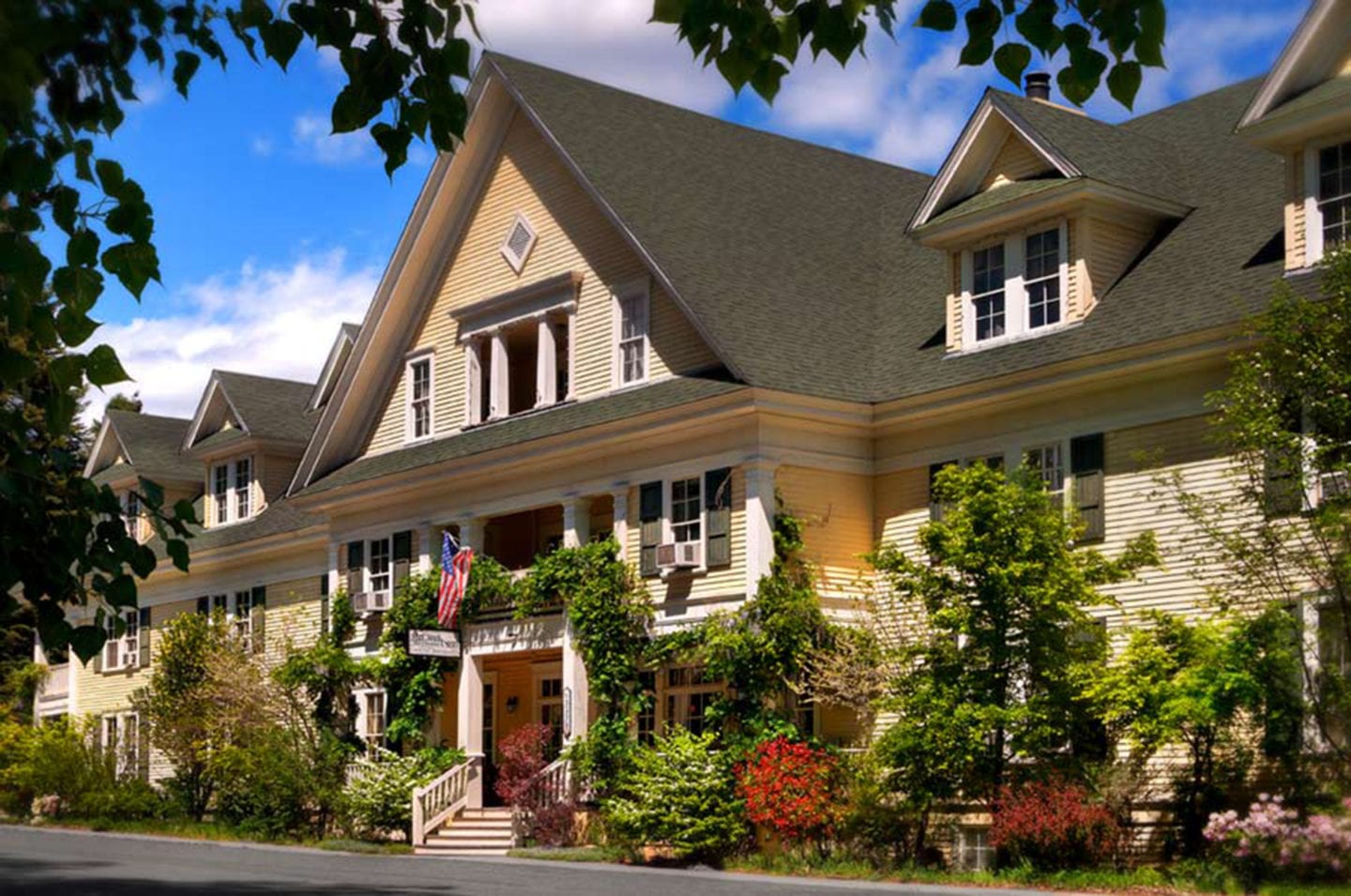
Tucked away in the pines near Twain Harte, the McCaffrey House Bed & Breakfast Inn offers a peaceful, cozy forest retreat within easy reach of Highway 108 and the western approach to Sonora Pass.

Fall color above Donner Lake in Truckee

Truckee

North of Lake Tahoe in the Sierra Nevada, the historic mountain town of Truckee is one of California’s premier autumn alpine destinations. Here, groves of aspen shimmer in gold throughout September and October. Beneath the canopy, mountain dogwoods burst with flashes of deep red, while the banks of local streams and rivers are lined with copper and rust-colored brush. Framed against towering green pines, the resulting landscape is rich with contrasts.

To find the most dazzling displays, follow the water. The paved Legacy Trail winds along the Truckee River directly from downtown, guiding walkers beneath a luminous canopy of golden cottonwoods. Nearby, the wide-open Martis Valley wetlands erupt in a sea of amber beneath rugged mountain peaks. For those looking to pair autumn foliage with more dramatic alpine views, follow the trails snaking through Coldstream Canyon and along the shores of Donner Lake.

Color here steadily builds from late September through mid-October, though individual pockets turn on their own clock depending on microclimates and elevation.

Where to Stay

Nestled on an acre of pines, maples, and aspens, Donner Lake Inn puts vibrant autumn foliage right outside your window. The lodge is a cozy base camp for exploring Donner Memorial State Park, historic downtown Truckee, and the surrounding trails.
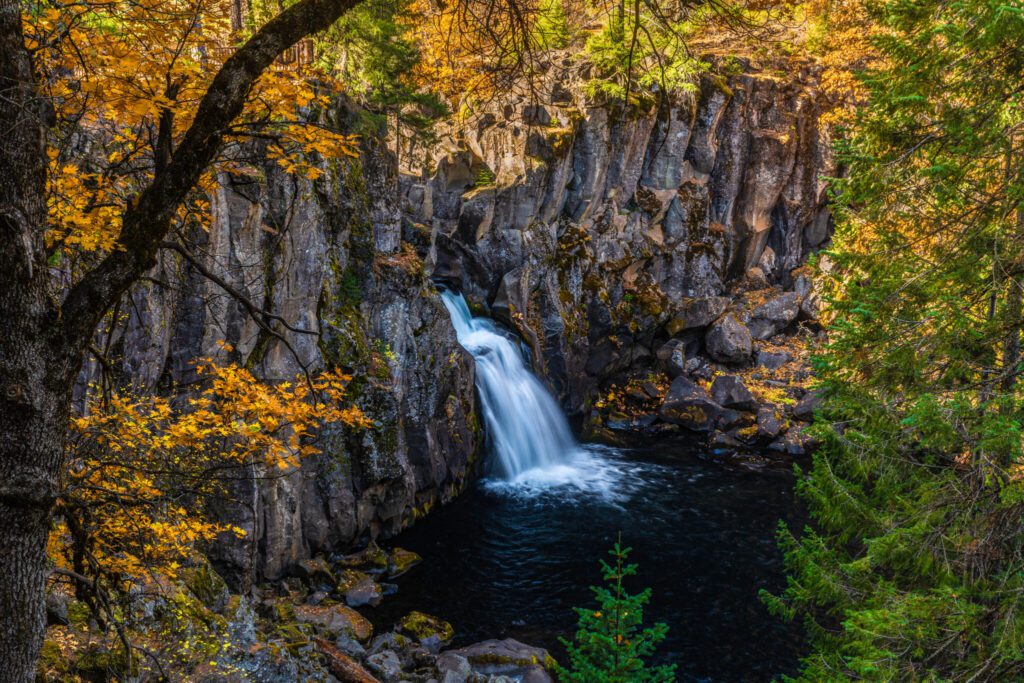
waterfall in a baslt canyon in autumn
Upper McCloud Falls

Mount Shasta

In California’s rugged far north, fall color makes a spectacular statement against the dark evergreen forests and volcanic landscapes surrounding Mount Shasta. A mix of bigleaf maples, quaking aspens, mountain dogwoods, and black oaks paints the wilderness in sweeping strokes of amber, orange, and burgundy. The displays of color generally peak in the second half of October but sometimes linger into early November.

The glassy waters of Lake Siskiyou offer an unforgettable starting point; its shoreline trail frames the fiery fall colors against the snow-capped peak of Mount Shasta. South of the volcano, a scenic drive down Highway 89 leads to the historic town of McCloud. Here, a riverside trail connects Lower, Middle, and Upper McCloud Falls, winding through a forested canyon speckled with fall color. If your timing is right, an early autumn dusting of fresh snow on the mountain’s peak provides a jaw-dropping backdrop that makes the golden valleys below look even more luminous.

Where to Stay

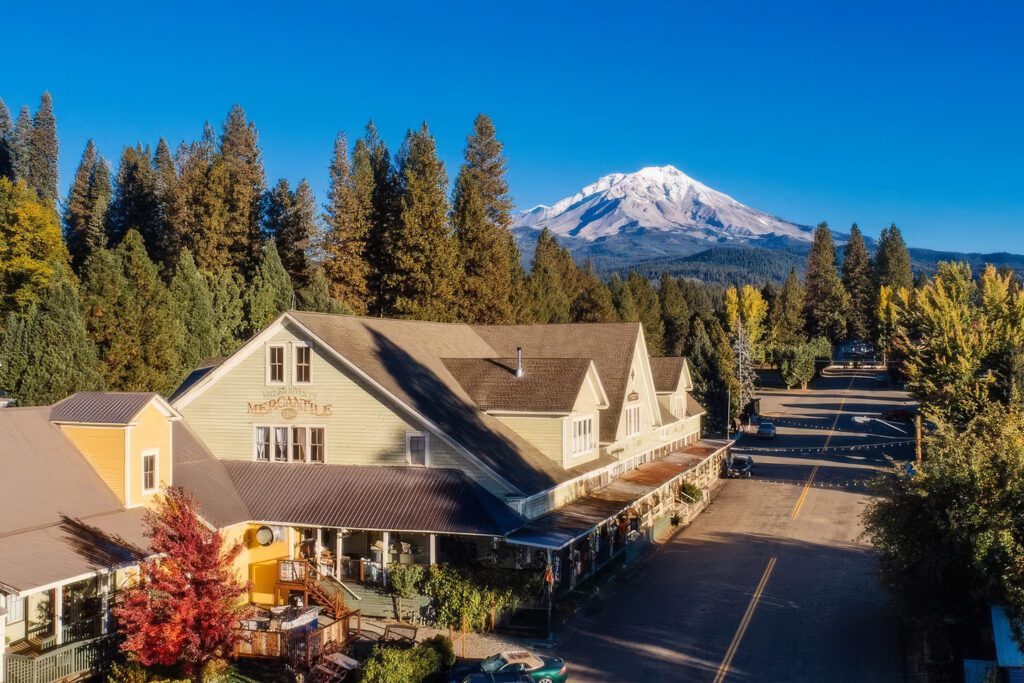
In the remarkably preserved historic logging town of McCloud, the McCloud Hotel, McCloud Mercantile Hotel, and McCloud River Bed & Breakfast each offer distinctive, charming stays within an easy drive of the McCloud River, Lake Siskiyou, and Mount Shasta trailheads.
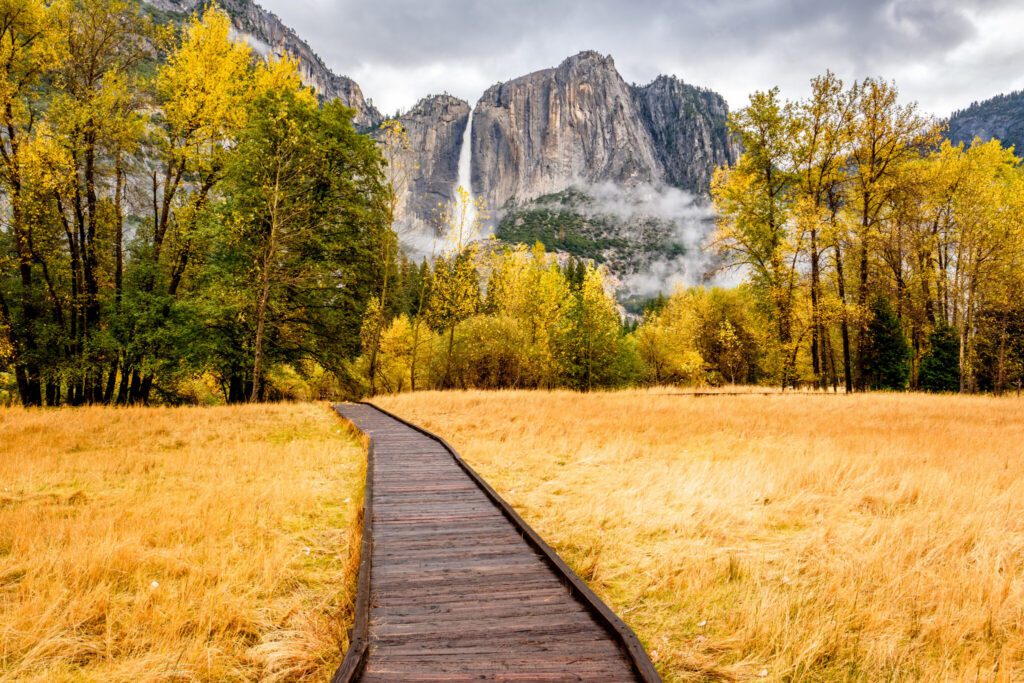
Meadow with boardwalk in Yosemite National Park Valley with Yosemite Falls at cloudy autumn morning. Low clouds lay in the valley.
Yosemite Falls in autumn

Yosemite

With evergreens dominating Yosemite’s vast wilderness, autumn here isn’t about entire mountainsides shifting color all at once. Instead, the magic lies in brilliant, painterly pockets of deciduous foliage that erupt in sharp contrast against towering granite monoliths, dark pine forests, and the rushing waters of the Merced River.

The floor of Yosemite Valley offers one of the state’s most rewarding places for fall color. Here, massive bigleaf maples line the riverbanks in ribbons of yellow, while ancient black oaks slowly ripen from gold to rust. Beneath the canopy, Pacific dogwoods paint the understory in shades of red, pink, and yellow, while black cottonwoods flutter like gold sunshine. For an unforgettable vignette, stop near the historic Yosemite Chapel, where a towering maple provides an exceptionally vivid splash of yellow and orange. At higher altitudes, road trippers will find scattered groves of golden aspens along the Tioga and Glacier Point Roads.

Yosemite’s transformation typically begins in mid-October and peaks in late October before bowing out to the first hard frost or early winter storm. While Yosemite Valley remains accessible year-round, travelers looking to explore the higher-elevation passes should monitor the weather closely, as early Sierra snows can trigger seasonal road closures.

Where to Stay

In the charming Gold-Rush town of Groveland, The Groveland Hotel offers a historic boutique hotel stay just 30 minutes from Yosemite’s Big Oak Flat Entrance. 
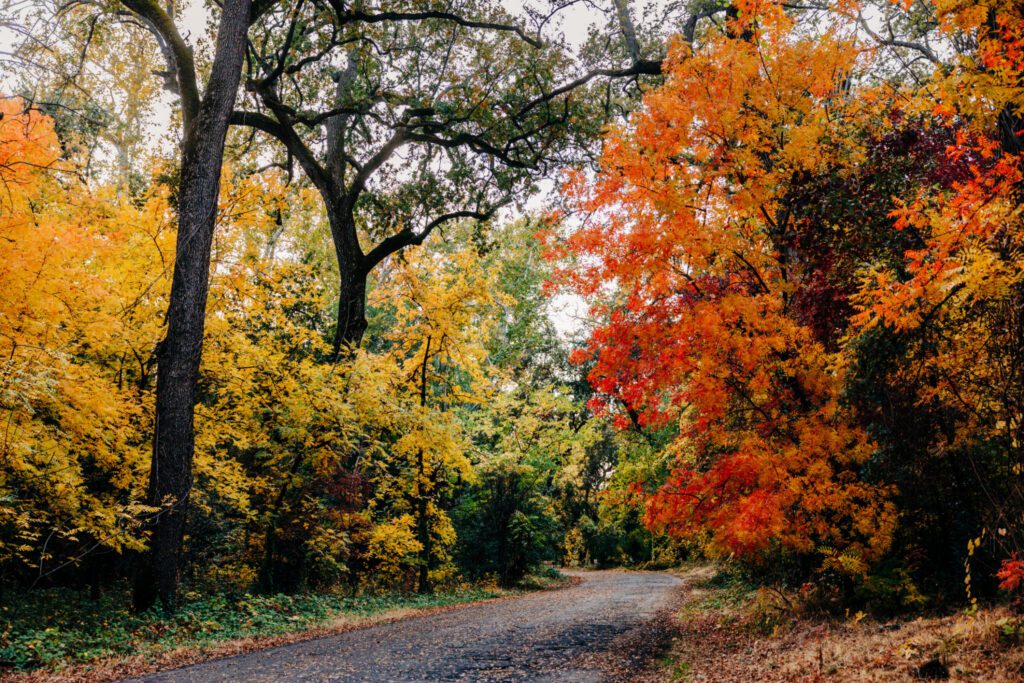
Fall scene in Bidwell Park with colorful foliage in Chico, CA
Fall foliage at Bidwell Park in Chico

Chico

Few destinations in California offer an urban fall foliage experience quite like the city of Chico. The city’s extensive urban forest turns shades of yellow, orange, and red, creating an autumn landscape that feels far removed from most of the state.

The crown jewel of this seasonal show is the sprawling, 3,600-acre Bidwell Park. Following the path of Big Chico Creek, a dense riparian canopy of towering sycamores, valley oaks, cottonwoods, and Oregon ash forms a glowing tunnel of color over miles of hiking and biking trails. The vibrant colors extend beyond the park, painting the brick paths and leafy courtyards of Chico State as well as the city’s historic, tree-lined streets. 

The seasonal show stretches from mid-October through mid-November, with the forested trails of Bidwell Park generally reaching their peak after the first of November.

Where to Stay

To stay in the heart of downtown Chico, check into Hotel Diamond, a beautifully restored historic landmark dating back to 1904. Alternatively, escape to Hotel Katerina, a stylish boutique stay that offers complimentary cruiser bikes—perfect for cycling under Bidwell Park’s autumn canopy.
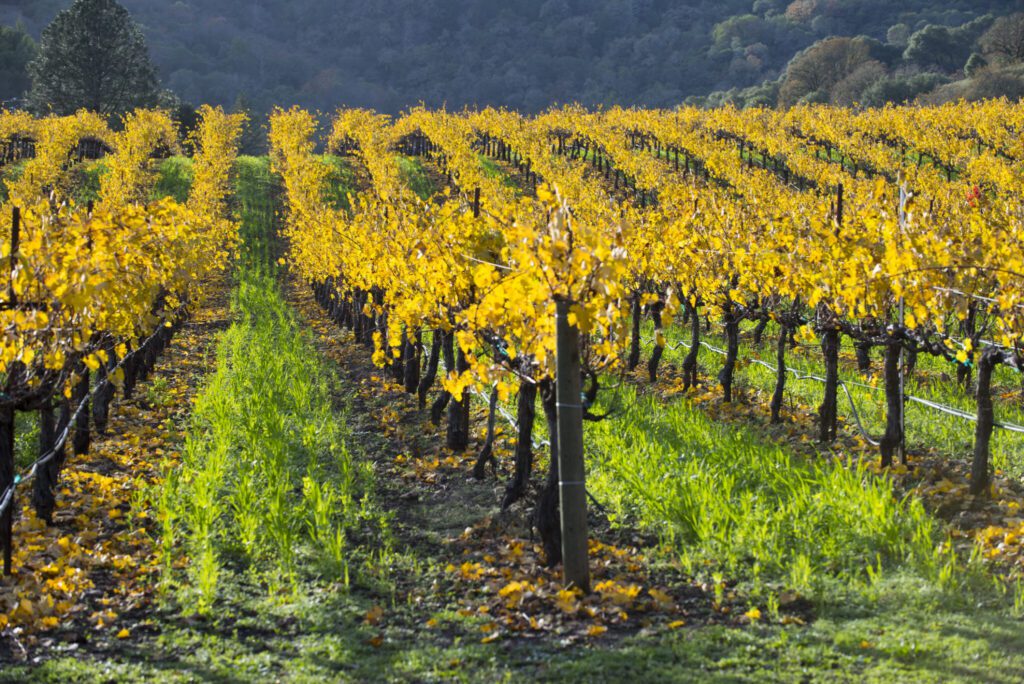
Vineyard with rows of yellow vines in the fall
Anderson Valley vineyard in the fall

Anderson Valley

Tucked into the rugged landscapes of Mendocino County, the Anderson Valley offers a stunning autumn showcase where dense, wild forests meet wine country. After the annual harvest, the valley’s rolling vineyards transition from deep green into a brilliant patchwork of yellow, orange, and red. Along the vineyards’ edge, the transformation is mirrored by changing bigleaf maples, valley oaks, and wild willows, adding layers of color to the countryside.

Highway 128 offers a beautiful drive to admire the spectacle. The road snakes through towering groves of redwoods and Douglas firs, punctuated by bright bursts of yellow maples, and opens to the expansive, colorful vineyards of the valley floor. Along the route, stop off at tasting rooms and the charming small towns of Boonville, Philo, and Navarro before continuing toward the Mendocino Coast. 

The seasonal transformation builds momentum throughout October and peaks from late October to early November, though individual grape varieties and microclimates dictate their own brilliant schedules.

Where to Stay

Right off Highway 128, The Madrones offers an elegant, Mediterranean-style estate compound complete with an on-site restaurant and tasting room. Just down the road in the heart of Philo, the Anderson Valley Inn provides an intimate, contemporary hideaway with quiet garden nooks. 
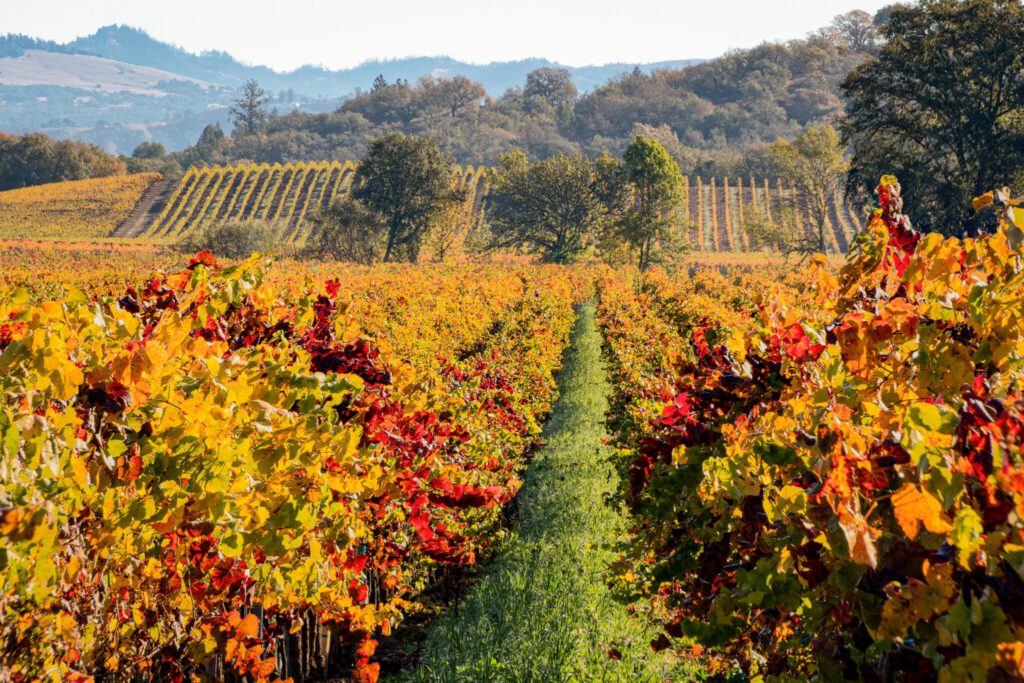
vineyard in with a range of fall colors
Sonoma County vineyard in fall

Sonoma Valley

While the frantic rush of harvest season draws the crowds, Sonoma Valley’s most breathtaking scenery arrives quietly after the last grapes are picked. Vineyard leaves turn brilliant shades of gold, amber, and burgundy, painting vibrant ribbons of color across the valley floor.

Driving the scenic Highway 12 corridor from Sonoma to Kenwood provides continuous panoramic views of colorful vineyard estates backed by rolling hills. For a deeply concentrated fall foliage display, visit the Sonoma Botanical Garden near Glen Ellen. Home to one of the largest wild-origin Asian plant collections in North America, this 67-acre sanctuary features nearly 50 rare species of Asian maples alongside luminous ginkgos, dogwoods, and dawn redwoods. 

While the colors begin changing in October, November marks the season’s peak, when the maples erupt into a brilliant display of crimson, orange, and even purple. The surrounding valley vineyards follow a similar timetable, extending their post-harvest color show through late November.

Where to Stay

Kenwood Inn & Spa is a romantic, Mediterranean-style boutique resort featuring beautiful courtyards draped in ivy that turns striking shades of crimson and rust in the fall. In Glen Ellen, The Gaige House offers a tranquil, Zen-inspired hideaway nestled along a creek, where courtyard gardens overlook fiery Japanese maples.
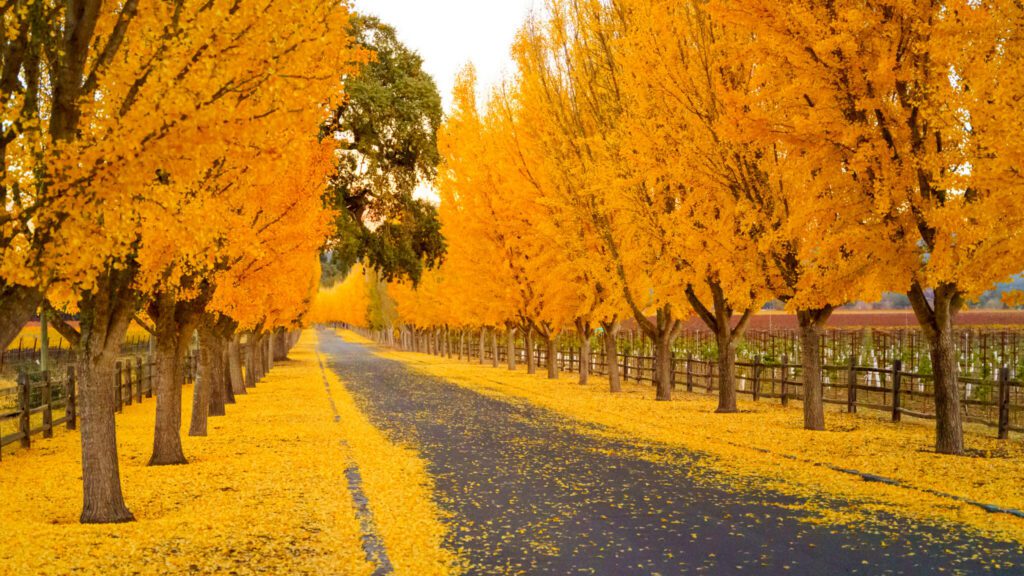
Ginkgo trees with gold-colored leaves line the road to a winery in Napa Valley
Ginkgo trees along the drive to Far Niente Winery in fall

Napa Valley

The world-renowned Napa Valley saves its most breathtaking scenery for late in the year, long after the harvest rush. As the autumn air cools, the rows of vineyards transform into a brilliant sea of gold, orange, and crimson. Overlooking the valley floor, deciduous trees add a rich kaleidoscope of color to the rolling hillsides.

To see autumn in Napa on display, cruise along the Silverado Trail or Highway 29 between Napa and Calistoga, or take the country roads threading through Yountville and Rutherford. For a peaceful hike, visit Bothe-Napa Valley State Park, where the trails wind beneath changing black oaks, bigleaf maples, and coastal redwoods. For a picture-postcard fall vignette, make a pilgrimage to Far Niente Winery in Oakville. Here, a spectacular, quarter-mile driveway lined with over 100 mature ginkgo trees erupts into a tunnel of gold-colored leaves. 

While subtle hints of color emerge in October, November remains the true peak month for Napa Valley’s foliage, with the vibrant leaves clinging to the vines well into late November.

Where to Stay

Just off the Silverado Trail along the Napa River, the Milliken Creek Inn offers a luxurious, secluded hideaway surrounded by Japanese maples and mature deciduous trees. In downtown Yountville, Maison Fleurie’s gardens and stone-climbing vines turn vivid shades of color, while a rooftop deck offers panoramic views of Napa’s colorful vineyards.
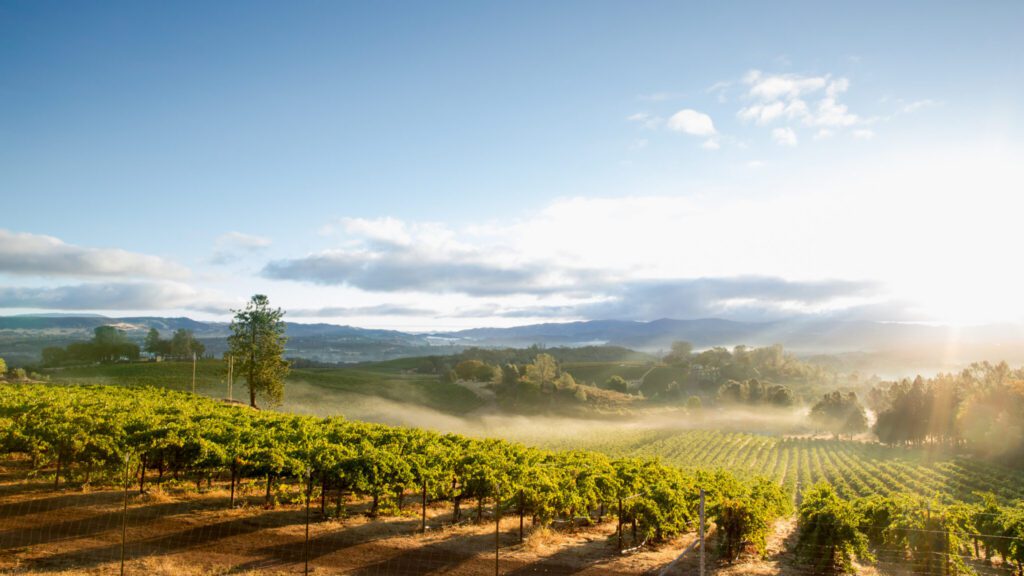
Sunrise overlooking a vineyard in Lake County, a tranquil, scenic Northern California wine district.
Sunrise overlooking a vineyard in Lake County

Lake County

Just north of Napa and Sonoma, Lake County offers a rugged, unhurried counterpoint to traditional California wine country. Here, the autumn palette is beautifully complex, as sweeping vineyard blocks mingle with historic pear and walnut orchards, ancient oak woodlands, and volcanic slopes cradling the glassy expanse of Clear Lake.

To watch the season unfold, wander the country roads around Upper Lake and cruise Highway 20, where rural barns are framed by the trees’ changing colors. Further south, the vast agricultural flatlands of the Big Valley erupt in a patchwork of amber, copper, and red as the orchards and vineyards transition together. Along the lake, the quiet trails of Clear Lake State Park offer a scenic vantage point where wild oaks turn deep shades of gold. 

Because Lake County sits at a higher elevation than its southern neighbors, it enjoys an extended fall season. Rather than peaking all at once, the native woodlands, orchards, and vineyards change on their own staggered clocks from late October well into late November.

Where to Stay

In Upper Lake, the meticulously restored Tallman Hotel is an enchanting base for exploring Clear Lake, local wineries, and the surrounding countryside. Nearby, Featherbed Railroad Bed & Breakfast offers one of the region’s most unique stays, with vintage railroad cabooses tucked beneath mature oak trees along the shores of Clear Lake.

Vineyards in the Santa Ynez Valley

Santa Ynez Valley

On the Central Coast, autumn brings a dramatic transformation to the Santa Ynez Valley. The rows of vineyards transform into an estate-wide tapestry of burnished bronze, gold, and deep crimson. This vibrant palette creates a stunning contrast against the valley’s golden hillsides and ancient oaks.

To experience the best of the season, escape the main highways to explore wine country’s backroads—like Foxen Canyon and Ballard Canyon—stopping at wine tasting rooms along the way. Because of the valley’s mild Central Coast climate, this autumn show arrives much later than in northern regions. The colors begin changing in late October, but November is the best month to catch the season at its peak. For a spectacular late-season finale, look for the towering cottonwoods along the Santa Ynez River, which burst into a glowing canopy of gold in late autumn.

Where to Stay

In downtown Los Olivos, the sophisticated Fess Parker Wine Country Inn places guests within walking distance of the valley’s premier tasting rooms. Nearby, The Ballard Inn offers a peaceful, farmhouse-chic stay with a wraparound porch and mature shade trees. In Santa Ynez, The Genevieve offers a pampered retreat surrounded by beautiful gardens and fire pits. 
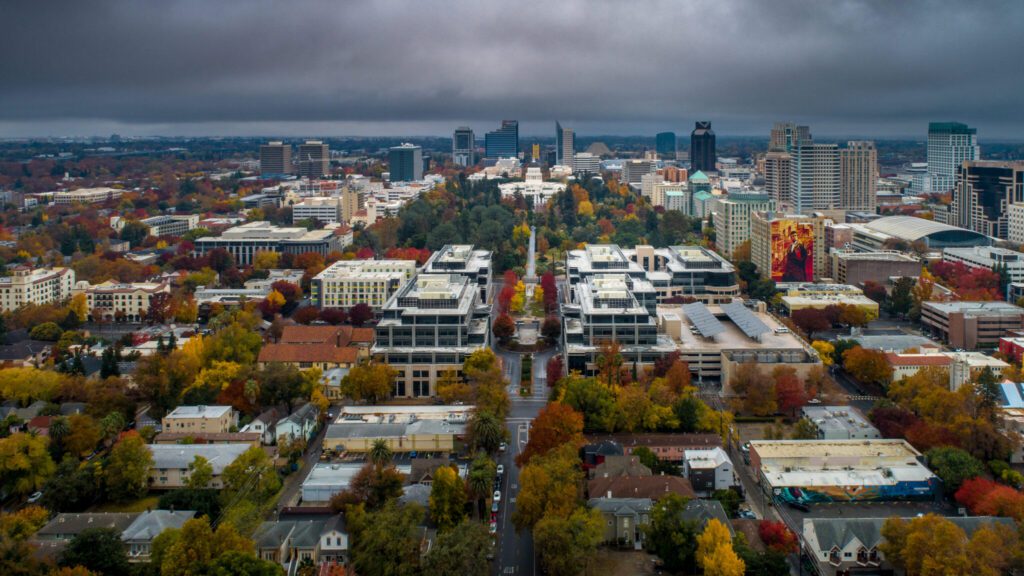
Aerial view of Sacramento State Capital Park and colorful trees in the fall
Sacramento’s colorful tree canopy in the fall

Sacramento

Known as the “City of Trees,” Sacramento shines in autumn, when its dense urban forest transforms the grid into a blazing canopy of color. The leafy streets of Downtown, Midtown, and East Sacramento ignite in dramatic shades of yellow, gold, orange, and red. Because the city’s remarkably diverse canopy blends Chinese pistache, liquidambars, maples, and luminous ginkgoes alongside stately oaks, elms, and London plane trees, it creates one of the most textured and prolonged late-season displays in the entire state.

To immerse yourself in the autumn show, take a leisurely stroll through Midtown’s tree-arched streets, wander the meticulously landscaped paths of Capitol Park, or venture into the historic residential pockets of East Sacramento. Unlike the high Sierra peaks where the foliage peaks and drops weeks earlier, Sacramento’s color display climbs steadily throughout November. The city’s trees typically reach their fiery crescendo right around Thanksgiving, with the vivid leaves often lingering through early December.

Where to Stay

To enjoy the autumn scenery right at your doorstep, check into The Fort Sutter Hotel or the historic Vizcaya, both offering stylish stays in Midtown. The Inn & Spa at Parkside provides a relaxing retreat adjacent to the mature groves of Southside Park, while The Exchange Sacramento delivers a sophisticated boutique experience right in the heart of downtown.
A Travel Guide to McCloud and Mt. Shasta’s Scenic Wonderland

Nestled in the forest on Mount Shasta’s southern slope, McCloud feels like a postcard from a bygone era. Founded in 1895, this former lumber company town retains much of its historic charm, while the surrounding landscape of rivers, waterfalls, forests, and mountains offers four seasons of outdoor adventure.

Autumn may be one of the loveliest times to visit, with crisp mountain days and vibrant fall colors inviting scenic drives, hikes, and fly fishing along the McCloud River. As the first snows arrive, McCloud dons its vintage holiday finery and transforms into a winter retreat for skiing, snowboarding, snowshoeing, and snowmobiling. Spring brings rushing waterfalls, trails dotted with wildflowers, and the return of fly-fishing season along the clear, spring-fed McCloud River. In summer, long sunny days open up even more outdoor fun, including paddling, rock climbing, mountain biking, and golf.

an aerial view of the small town of McCloud surrounded by forests with Mount Shasta rising in the background
Historic McCloud

Step Back in Time in Historic McCloud

Established in 1895, the town was built for the McCloud River Lumber Company and its employees. At its height, the company owned or controlled over 600,000 acres of timberland and was home to California’s largest lumber operation. The company built and owned everything in town: the mercantile, the cafés, the hotel, and all the homes for its employees. McCloud remained a company town until it was privatized in 1963. As a result, much of the town’s historic architecture and charm remains fully intact. Today, downtown McCloud is listed on the National Register of Historic Places, with 17 buildings designated as historic landmarks.

Stroll along Main Street to admire the preserved architecture and browse local shops and restaurants. The 1897 McCloud River Mercantile Company sits at the heart of the historic district. The old-fashioned general store curates heritage Americana and modern alpine brands, along with an array of local artisan finds. A dedicated corner of the mercantile operates as an old-fashioned candy store, complete with jars of nostalgic sweets and gourmet treats.

Dining options range from made-from-scratch breakfasts and lunches at Traci’s White Mountain Café, housed in a vintage soda-fountain shop, to Pacific Northwest comfort cuisine at the Meat Market. Up the street, the elegant Sage Restaurantserves seasonal California cuisine inside the historic McCloud Hotel, with dinner moving onto a pergola-covered garden terrace in warmer months. For old-school burgers and milkshakes, Floyd’s Frosty pairs casual fare with views of Mount Shasta from its outdoor patio.

The McCloud Outdoors & Gear Exchange is a trusted local outfitter for camping, hiking, and fishing. They also provide kayak and SUP rentals for paddling the McCloud Reservoir. For a deeper dive into the town’s lumber and railroad history, stop by the McCloud Heritage Junction Museum. 

waterfall in a baslt canyon in autumn
Upper McCloud Falls

Chase Waterfalls Along the McCloud River

Just a few miles outside of town, the McCloud River tumbles through a forested volcanic landscape on its way past three dramatic waterfalls. A roughly four-mile out-and-back trail connects Upper, Middle, and Lower Falls, or you can reach each waterfall separately by car.

At Upper Falls, the river rushes through a narrow basalt canyon before plunging into a deep, churning pool. The most majestic of the three, Middle Falls drops 44 feet over a broad basalt cliff into a pool framed by dramatic rock formations; in autumn, changing foliage makes the scene especially photogenic. Lower Falls is gentler, with water tumbling over a broad volcanic ledge into a calm pool that becomes a popular swimming hole in summer.

Many more magical waterfalls are just a short drive from McCloud. Two of the most accessible are 50-foot Faery Falls, reached via a short hike on the Ney Springs Canyon Trail, and Hedge Creek Falls, where a small cave allows visitors to walk behind the waterfall.

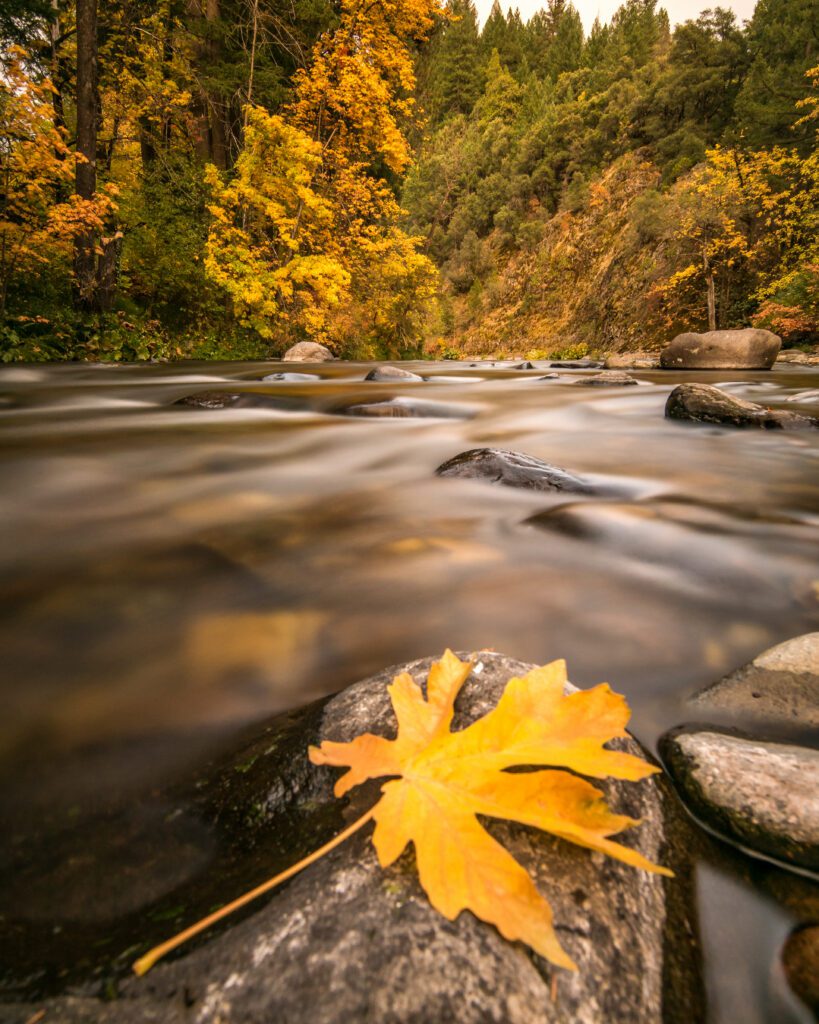
a fallen leaf on a rock on the McCloud River with fall color
McCloud River in the fall

Cast a Line in Legendary Trout Waters

Anglers have long been drawn to the cold, clear waters surrounding McCloud. Cast for trout along the Upper McCloud River, head to deeper water at McCloud Reservoir, or fly-fish the storied Lower McCloud.

The Kerry Landreth Preserve protects the remote, wild trout habitat along the lower McCloud. Here, the river runs through a dramatic canyon flanked by dense forest, massive boulders, and sheer cliffs. Managed by The Nature Conservancy, the spectacular 2,330-acre preserve offers hiking trails and strictly catch-and-release fishing, with public access limited to just 10 anglers per day.

For visitors who would rather leave the logistics to someone else, several local outfitters offer guided fly-fishing excursions for everyone from first-timers to experienced anglers. 

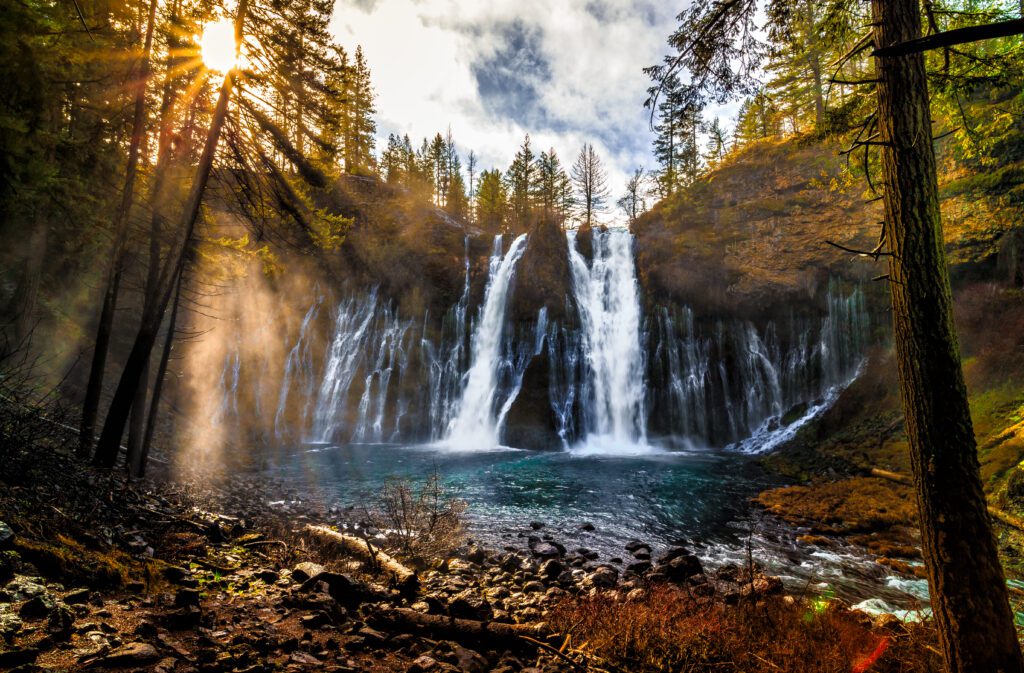
McArthur-Burney Falls in Autumn
McArthur-Burney Falls Memorial State Park

Take the Scenic Route

McCloud is an ideal base camp for exploring Northern California’s volcanic landscapes. The 500-mile Volcanic Legacy Scenic Byway travels from Lassen Volcanic National Park to Crater Lake National Park. Highlights along the route include Lake Almanor, McArthur-Burney Falls, and Mount Shasta, with a popular side trip to see the granite spires at Castle Crags State Park.

About 45 minutes southeast of McCloud, McArthur-Burney Falls Memorial State Park showcases one of Northern California’s most unusual waterfalls. At Burney Falls, water not only pours over a 129-foot ledge but also emerges from subterranean springs along the volcanic rock face, creating a thundering wall of water and mist nearly 250 feet wide.

During peak summer periods, advance day-use reservations may be required, so check California State Parks for current requirements before visiting. Fall and winter bring fewer crowds, but freezing temperatures can cause ice to accumulate on the trail to the waterfall’s base, making conditions hazardous.

Heading in the opposite direction, Castle Crags State Park lies about 30 minutes southwest of McCloud and rewards hikers with dramatic views of glacier-polished granite spires rising above the forest. An easy walk to Vista Point reveals sweeping views of Castle Crags and Mount Shasta, while more ambitious hikers can tackle the strenuous Crags Trail toward Castle Dome. The Pacific Crest Trail also winds through the park.

McCloud Hotel exterior in winter
McCloud Hotel

Experience McCloud Through the Seasons

McCloud’s small-town charm shines during its annual festivals. Each October, the Apple Harvest Festival fills historic Main Street with live music, artisan vendors, fresh-pressed cider, and an apple dessert contest.

By December, the town transforms into a Victorian-themed wonderland for its annual McCloud Vintage Christmas festivities. Historic buildings glow with lights and decorations, and seasonal events include horse-drawn carriage rides, holiday markets, and choral performances.

Once the snow settles in, McCloud shifts fully into winter mode. Mt. Shasta Ski Park is just a few miles outside town for downhill skiing and snowboarding, while the Mt. Shasta Nordic Center maintains trails for cross-country skiing. Snowshoeing provides a quieter way to explore the surrounding forests.

In summer, the calm, turquoise waters of the McCloud Reservoir draw kayakers, paddleboarders, boaters, and anglers to its pine-rimmed shores. At the McCloud Golf Club, golfers can play a historic nine-hole course beneath towering pines with views of Mount Shasta’s snow-capped peak. 

Where to Stay in McCloud

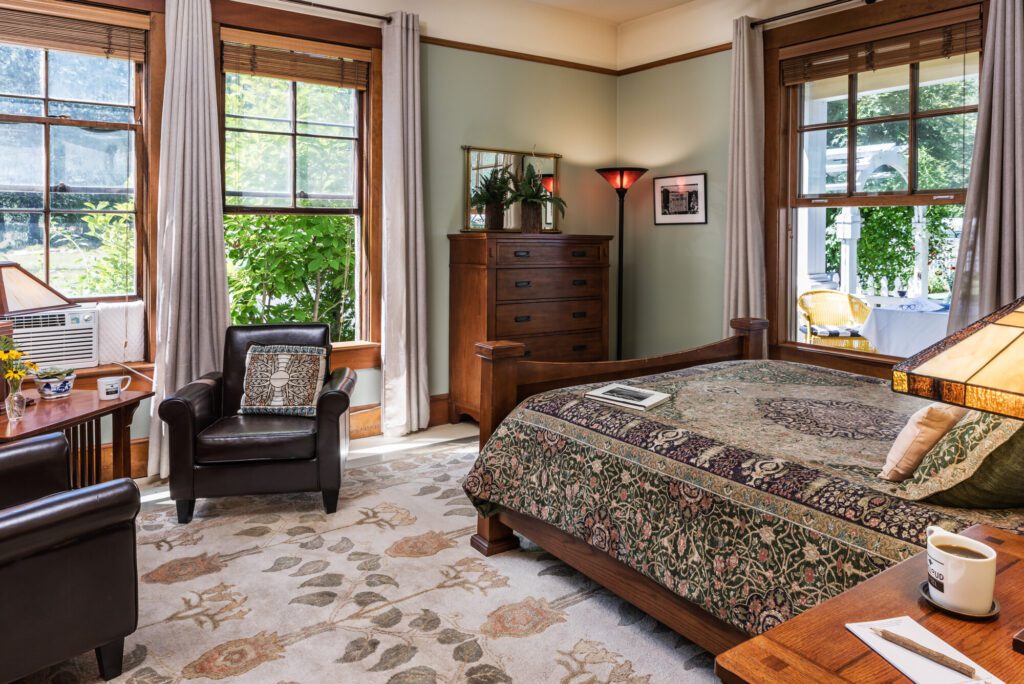
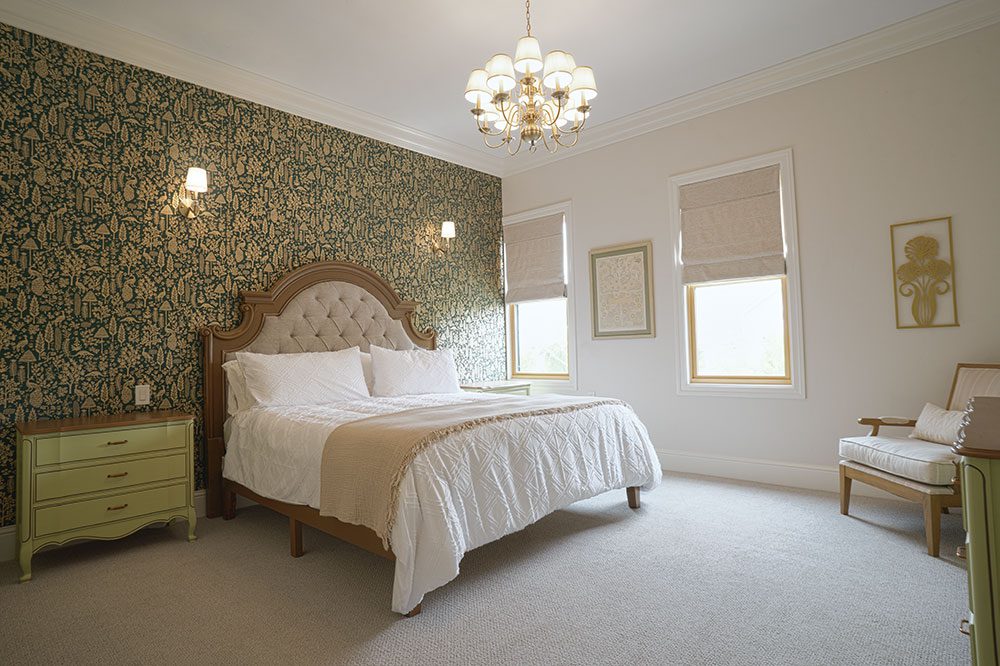
Art & Crafts inspired hotel guest room at the McCloud Hotel
Deluxe queen guest room at the McCloud Hotel

McCloud Hotel

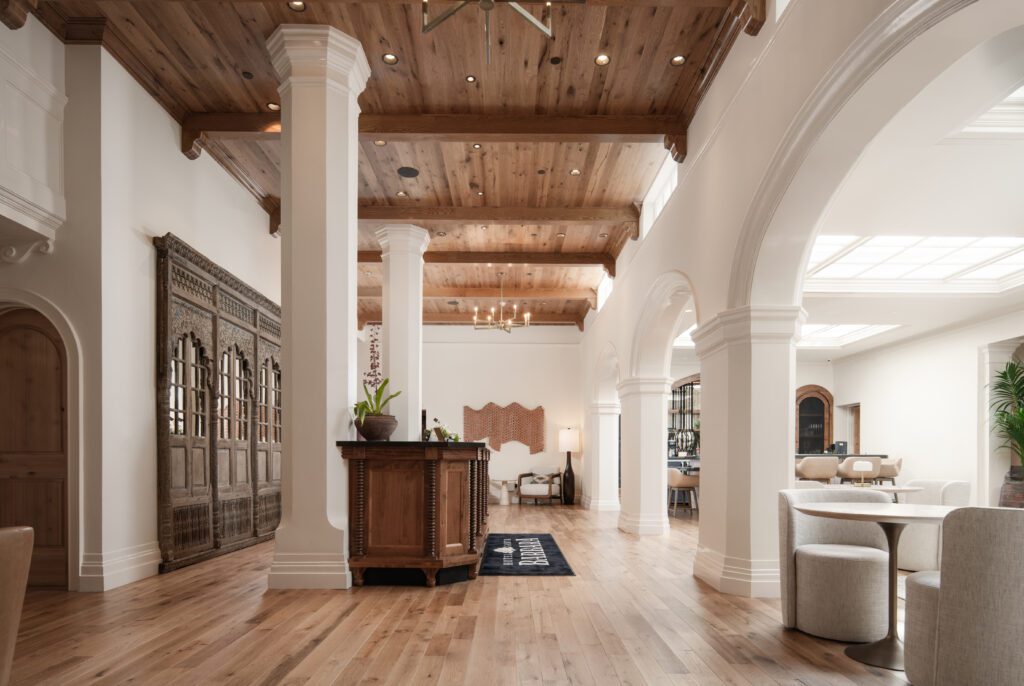
Built in 1916 for the McCloud River Lumber Company, the beautifully restored McCloud Hotel pairs Arts and Crafts elegance with the warmth of a mountain retreat. Original box-beam ceilings, built-in bookcases, and the historic registration desk recall its early days, while mission-style guest rooms provide a cozy place to return after exploring. Linger beside the lobby fireplace, settle onto the front porch, or enjoy seasonal California cuisine at Sage Restaurant and its garden terrace.

Shasta Wintu Suite at the McCloud Mercantile Hotel

McCloud Mercantile Hotel

Stay in the heart of historic downtown at the McCloud Mercantile Hotel, located above the shops and restaurants of the landmark McCloud River Mercantile. Individually designed guest rooms draw inspiration from the people and eras that shaped the region, including Native American tribes, pioneers, lumber mills, railroads, and photographers. Twelve-foot ceilings, luxurious beds, heated bathroom floors, and spacious soaking tubs bring modern comforts to the character-filled historic setting.

Mother McCloud Suite at the McCloud River B&B

McCloud River Bed & Breakfast

Surrounded by lawns and towering trees, McCloud River Bed & Breakfast occupies a beautifully restored 1903 landmark once home to the lumber company’s bank, offices, and telephone switchboard. Guest rooms incorporate original architectural details and period touches that reflect the building’s history, while one particularly unusual remnant has taken on a new purpose: the former bank vault is now a private dining room. The five-acre setting offers a peaceful retreat just beyond historic downtown.
Mount Shasta & Trinity Alps Wilderness

Majestic Peaks, Alpine Wilderness, and Historic Towns

In California’s far north, snowcapped Mount Shasta rises above dense forests, volcanic terrain, pristine rivers, and rugged alpine wilderness. To the west, the Trinity Alps reveal a less-traveled world of granite peaks, glacial lakes, and remote backcountry trails. These extraordinary landscapes offer a quieter, less-traveled side of Northern California, with remarkable opportunities for hiking, fishing, and wilderness adventures.

Middle falls on McCloud River

Rising to more than 14,000 feet, Mount Shasta dominates the surrounding landscape. In summer, explore its forested trails, visit the clear waters of Lake Siskiyou, or head to Castle Crags State Park for dramatic views of granite spires. Winter brings skiing, snowshoeing, and other adventures to the mountain’s snowy slopes.

an aerial view of the small town of McCloud  surrounded by forests with Mount Shasta rising in the background
Historic McCloud

McCloud

Just southeast of the mountain, McCloud preserves the character of a historic lumber town. Its charming downtown features century-old buildings, local shops, and inviting restaurants. Nearby, the storied McCloud River has long attracted anglers to its cold, clear, spring-fed waters. The river’s three celebrated waterfalls—Lower, Middle, and Upper Falls—cascade through beautiful forest settings, drawing hikers and photographers. Follow the Volcanic Legacy Scenic Byway east of town to McArthur-Burney Falls Memorial State Park, home to one of Northern California’s most spectacular waterfalls.

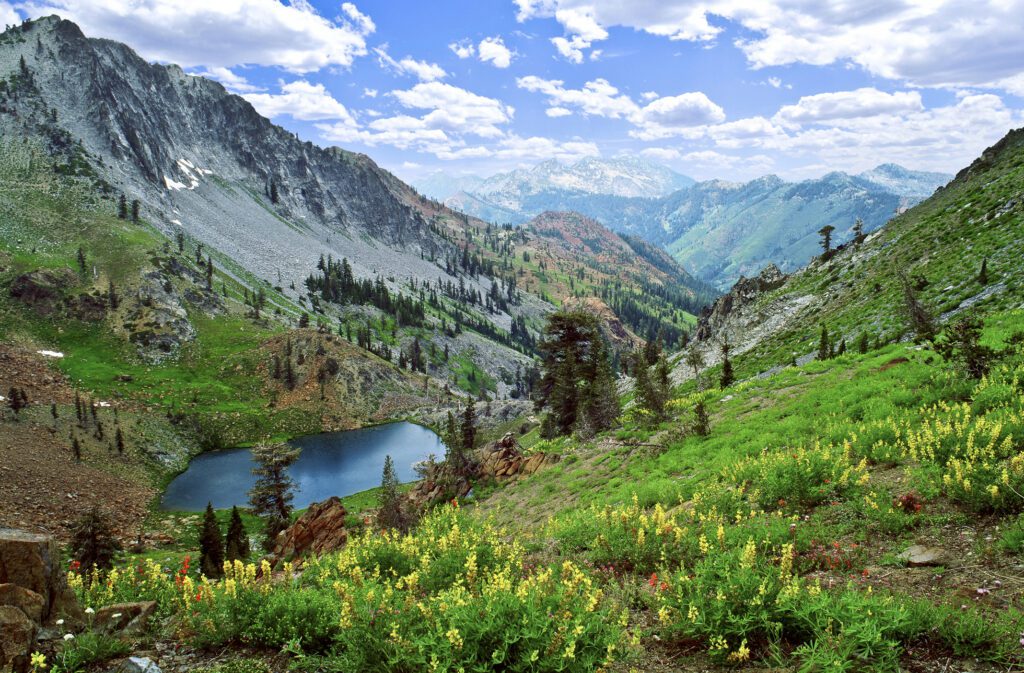
A dramatic alpine landscape to granite peaks, wildflowers, and a deep valley with a lake
Deer Lake in the Trinity Alps Wilderness

Weaverville

West of Mount Shasta, Weaverville is a beautifully preserved Gold Rush town and a gateway to the Trinity Alps Wilderness. Stroll its historic Main Street, visit the remarkable 19th-century Joss House State Historic Park, or discover the area’s gold-mining heritage. Beyond town, the Trinity Alps offer spectacular hiking, backpacking, fishing, and alpine lake adventures. The nearby Trinity River is also a celebrated destination for fishing and whitewater rafting.

Aerial view of downtown Weaverville near the Trinity Alps

The Enduring Historic Charm of California’s Oldest Hotels

California’s oldest hotels are more than places to spend the night—they are living pieces of the state’s history. Some began as Gold Rush-era saloons and stagecoach stops. Others rose from the ashes of devastating fires and earthquakes or welcomed generations of artists, entertainers, and world leaders. Together, they tell the story of California’s evolution from frontier outpost to global destination. For a century or more, these enduring landmarks have witnessed many of the state’s defining moments while continuously reinventing themselves for new generations. Rich with architectural character, stories, and a deep sense of place, they offer travelers something increasingly rare: the chance to experience California history firsthand.

The Groveland Hotel
The Groveland Hotel

The Groveland Hotel

Built in 1849, The Groveland Hotel was founded as the Garrote Hotel in a rough-and-tumble Gold Rush town known for frontier justice and a grim name that meant “death by strangulation.” Originally built as a trading post, the building quickly became a lodge for miners as well as a saloon, gambling hall, and brothel. When local residents sought a more respectable future, Garrote was renamed Groveland in 1875, and the hotel followed suit. The arrival of Yosemite-bound tourists and, later, engineers working on San Francisco’s Hetch Hetchy water project brought cycles of prosperity. Today, the hotel’s original adobe walls remain, while the renovated interiors blend Gold Rush-era charm with modern amenities. Local legend holds that a long-departed miner named Lyle still haunts Room 15, making it one of the property’s most requested accommodations.

Standard King room at the Upham Hotel

The Upham Hotel

Opened in 1871 as the Lincoln House, The Upham Hotel is Santa Barbara’s oldest continuously operating hotel. Built by Amasa Lincoln, a distant cousin of Abraham Lincoln, the New England-style boarding house welcomed pioneer settlers arriving by horse, steamship, and on foot. As Santa Barbara grew, successive owners expanded and improved the property, including Cyrus Upham, who renamed it Hotel Upham in 1898. The landmark survived both the devastating 1925 Santa Barbara earthquake and the hardships of the Great Depression. Today, the 50-room boutique hotel preserves its historic character across the original main building, annex, and carriage house, along with seven secluded cottages tucked among lush gardens just two blocks from State Street.

Guest room with a corner fireplace, bay window, and contemporary furnishings.
Guest room in the Bakery Building at Maison Fleurie

Maison Fleurie

Built in 1873 as the Magnolia Hotel, Maison Fleurie is the oldest continuously operating hotel in Napa Valley. Constructed of local stone beside the railroad tracks in what would become Yountville, the hotel served over the years as a lodge, saloon, and rumored bordello. Over the years, the property acquired bricks from a demolished church and a balcony salvaged from San Francisco’s old French Hospital. The bricks remain on display in the dining room and historic fireplace, while the balcony still graces the building’s stone façade. After years of disrepair and abandonment, the landmark was carefully restored and reimagined as Maison Fleurie, meaning “flowering house.” Today, the 13-room boutique inn blends its rich past with French-inspired elegance, lush gardens, and newly revamped guest rooms just steps from Yountville’s acclaimed restaurants and tasting rooms.

Guest room of The Monte Cristo

The Monte Cristo

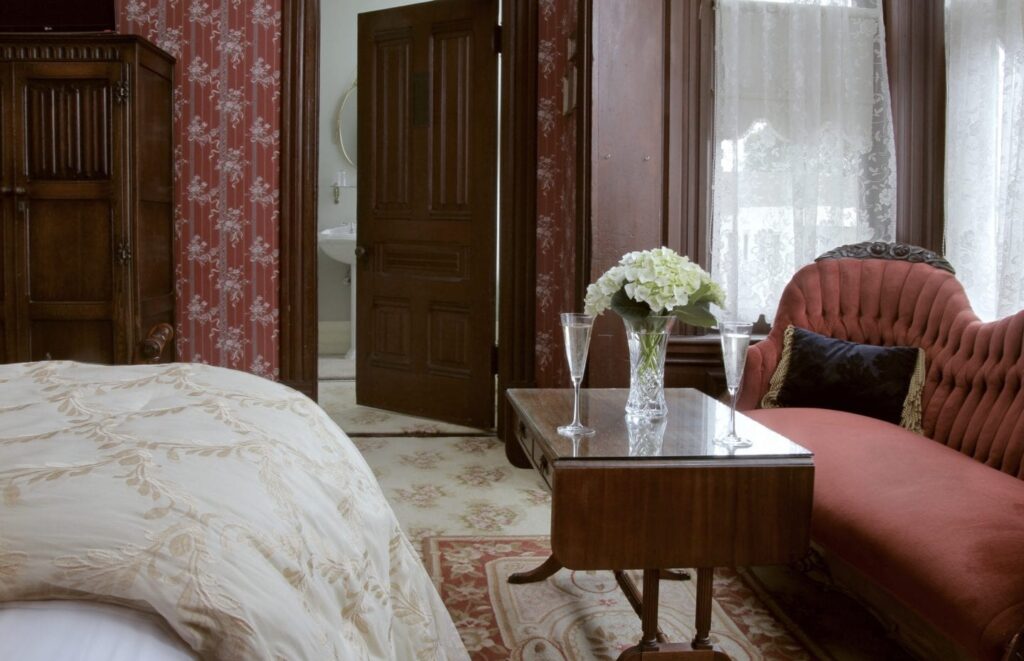
Originally built in 1875 as a bordello and saloon, The Monte Cristo is widely considered San Francisco’s oldest surviving hospitality building. It stood through the devastating 1906 earthquake and the fires that followed, serving as a refuge for residents left homeless by the disaster. During Prohibition, it became a speakeasy, and in the years that followed, San Francisco grew up around it. Many of the hotel’s original architectural details remain, including the façade, hardwood floors, high ceilings, and even some of the building’s hand-painted signage. Carefully restored in impeccable Victorian style, the hotel recreates the ambiance of a bygone era with Persian rugs, Bradbury & Bradbury wallpapers, intricate crown molding, vintage light fixtures, and exquisite antiques. Among the few nods to the 21st Century are the soundproofed rooms, Smart TVs, and luxurious marble bathrooms equipped with towel warmers and electronic bidets. 

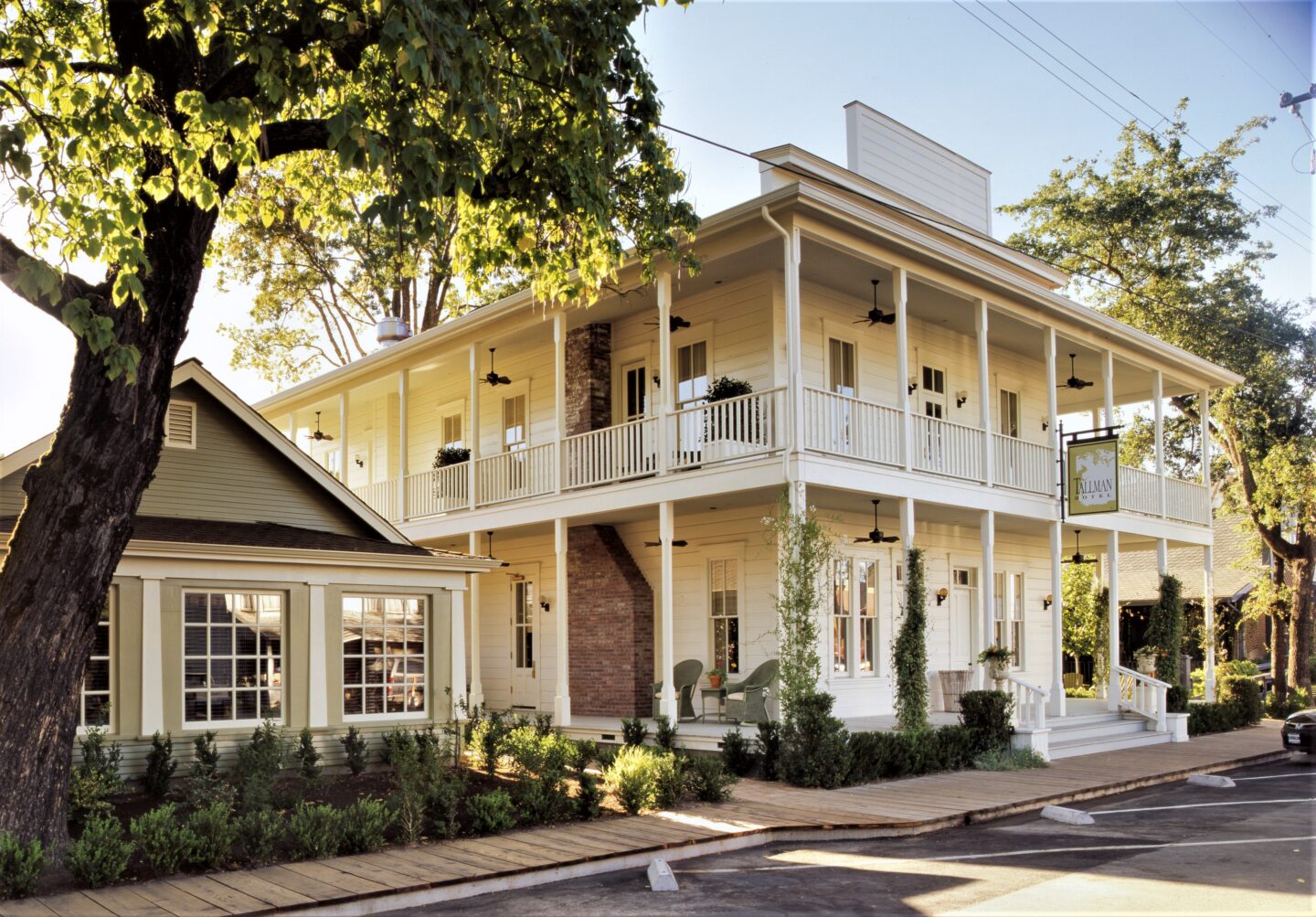
Exterior of the Tallman Hotel
Tallman Hotel

Tallman Hotel

Built in the 1870s by pioneer settler Rufus Tallman, the Tallman Hotel welcomed well-heeled travelers who journeyed by stagecoach from Sacramento and San Francisco to soak in Lake County’s famed mineral springs. After the original hotel was destroyed by fire in 1895, the family rebuilt it. The Tallmans’ daughter and son-in-law later inherited it, renamed it Riffe’s Hotel, and continued to run it for decades. Next door, the family’s Blue Wing Saloon remained a popular gathering place until it was torn down during Prohibition. In the 1940s and 1950s, the hotel served as a boarding house and then a retirement home before standing vacant for 40 years. In 2003, new owners painstakingly restored the hotel to its original grandeur, salvaging many architectural details, including the original fir floors, staircases, and banisters. Today, the beautifully preserved hotel and the rebuilt Blue Wing Saloon honor Upper Lake’s stagecoach-era past while welcoming a new generation of travelers.

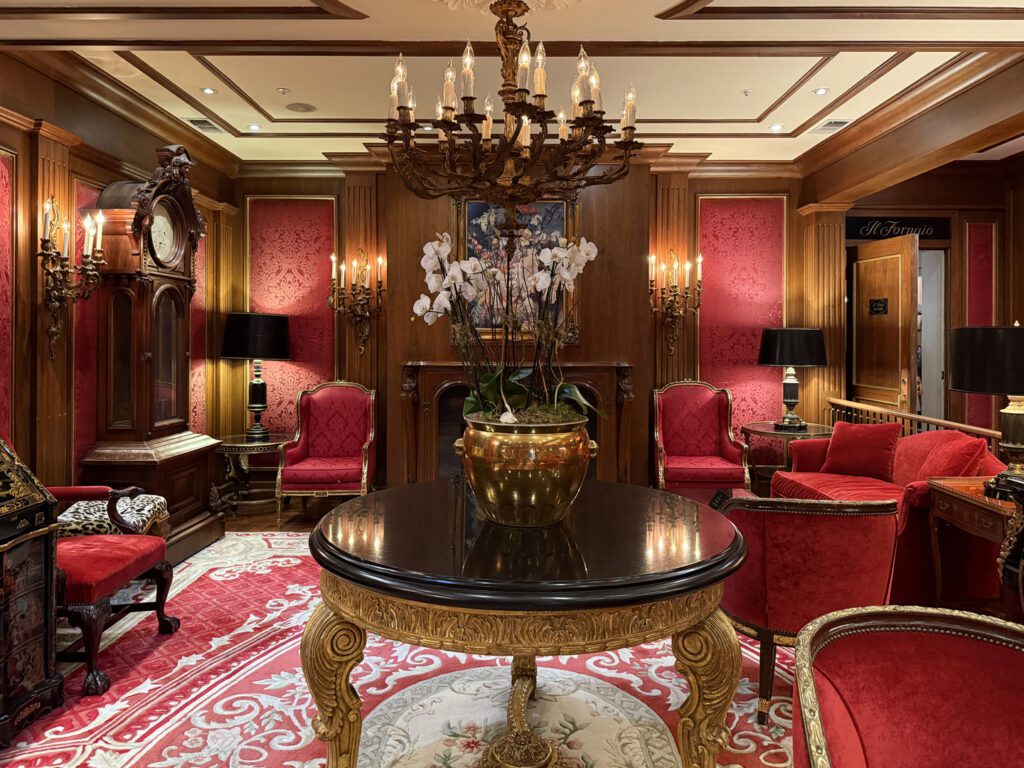
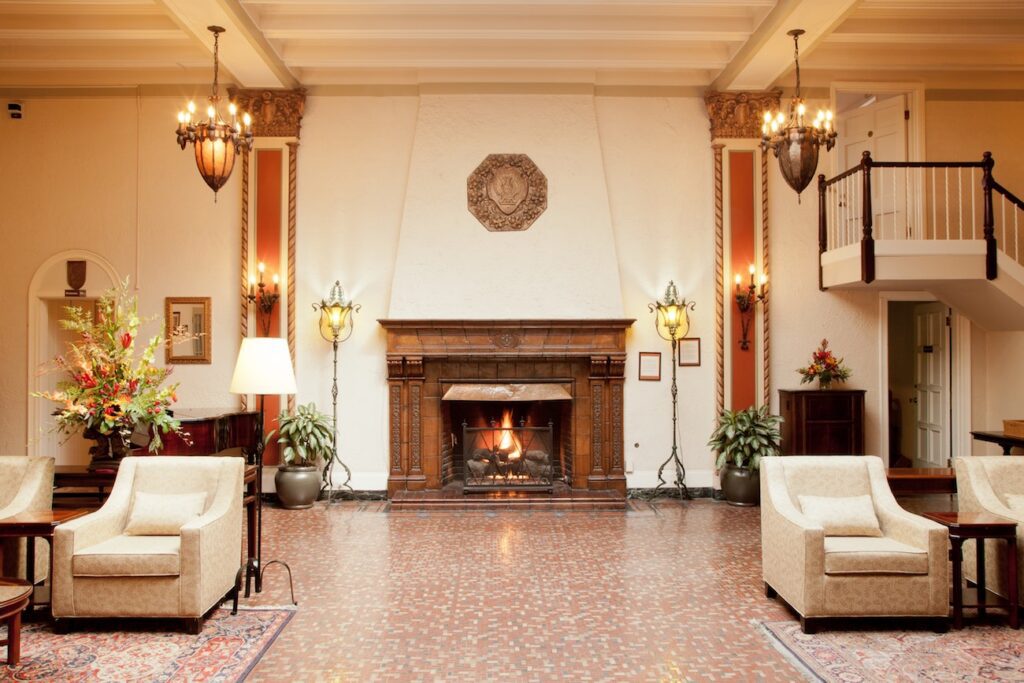
Intiamte hotel lobby with red velvet seating, red silk wall panels, dark wood trim, antiques, and a fireplace.
Lobby of the Pine Inn

Pine Inn

Built in 1889 as the Hotel Carmelo, the Pine Inn is the oldest hotel in Carmel-by-the-Sea. It was constructed from wood salvaged from San Francisco’s Tivoli Opera House and originally stood several blocks from its present location. As the young town grew, the main building was dismantled and rolled down Ocean Avenue on pine logs before being rebuilt and enlarged as the Pine Inn in 1903. The hotel quickly became Carmel’s social center, hosting town dances, church services, Shakespeare readings, and literary gatherings. Today, the landmark remains at the heart of village life on Ocean Avenue, blending historic character with modern comforts just steps from Carmel’s shops, galleries, restaurants, and beach.

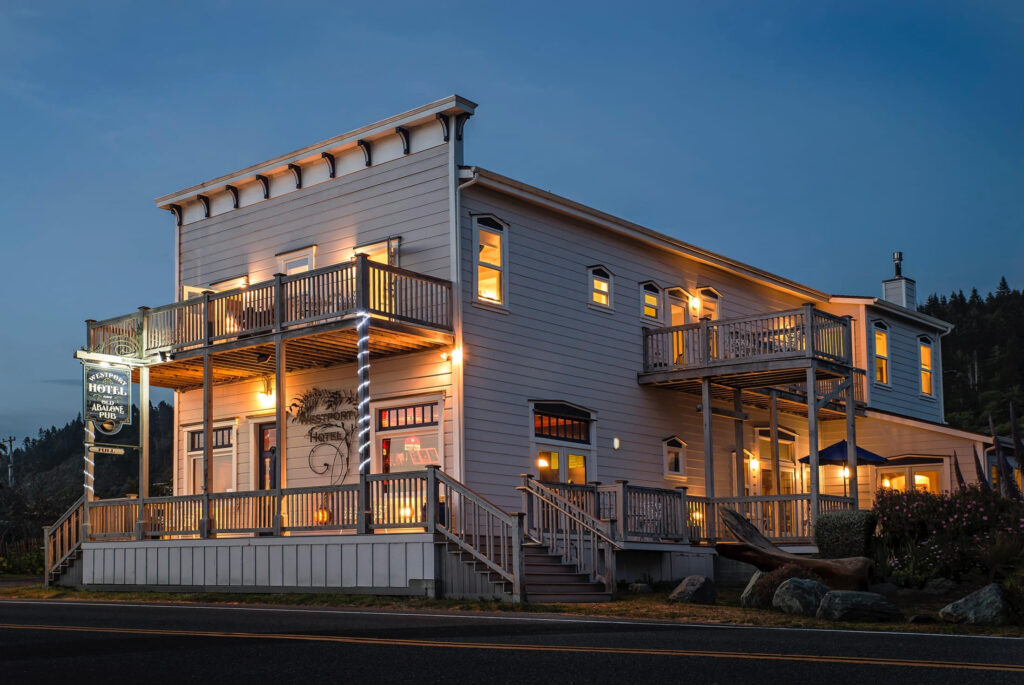
Exterior of the Westport Hotel at dusk
Westport Hotel

Westport Hotel

Built in 1890 during Westport’s logging boom, the Westport Hotel & Old Abalone Pub welcomed lumbermen, fishermen, and travelers navigating the rugged Mendocino Coast. Founded just a decade after the town itself, the Victorian hotel stood above a small but busy port where ships braved treacherous waters to carry redwood lumber to markets throughout California. Over the decades, the property underwent several incarnations before it was purchased in 2008 by longtime residents Lee Tepper and Dorine Real. The couple had worked at the hotel’s restaurant when they first moved to Westport in 1974 and sought to restore the historic character that had been stripped away over the years. Today, the beautifully preserved inn and cozy pub offer a memorable stop along California’s iconic Highway 1, overlooking one of the state’s most remote and dramatic stretches of coastline.

Olivia Room at the Victorian Inn

Victorian Inn

Built entirely of local redwood in 1890, the Victorian Inn stands as one of the crown jewels of Ferndale’s remarkably preserved Main Street. Designed by noted architect Thomas J. Frost, the grand Stick Style-Eastlake Victorian building showcases ornate bay windows, intricate millwork, Italianate detailing, and a distinctive mansard-style roofline. Constructed during Ferndale’s prosperous dairy and timber boom, the hotel has long stood at the heart of one of California’s best-preserved Victorian villages. Today, many of the hotel’s original architectural features remain, including soaring ceilings, redwood trim, vintage fixtures, and elegant bay windows that continue to evoke the grandeur of the late 19th century. The location is just steps from Ferndale’s charming shops and a short drive from Redwood National and State Parks.

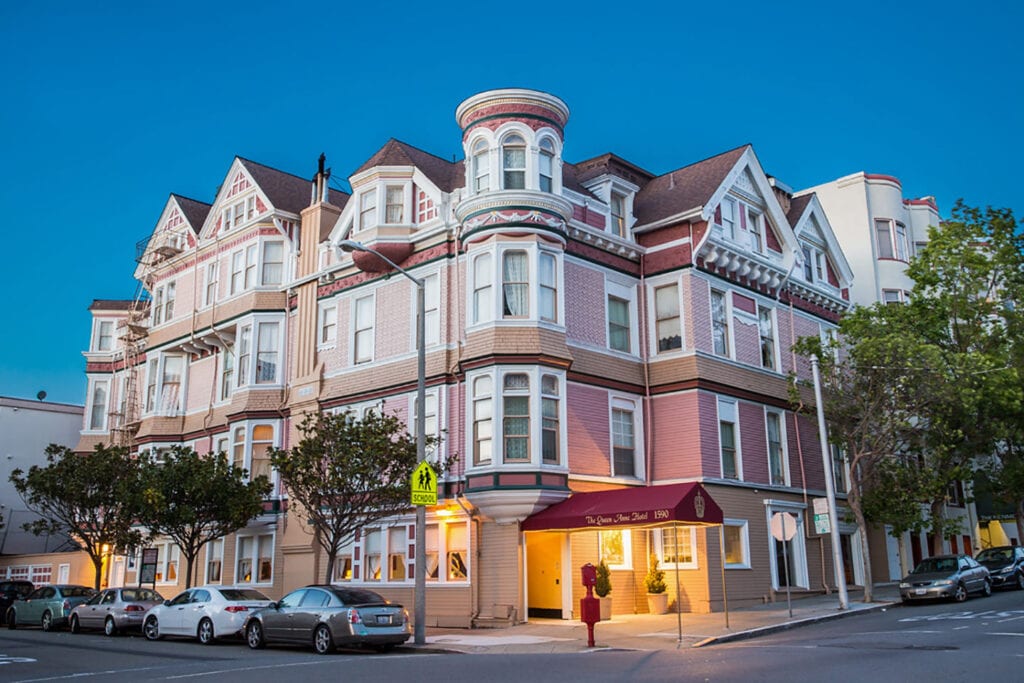
Exterior of the Queen Anne Hotel at dusk

The Queen Anne Hotel

Built in 1890, The Queen Anne Hotel rose from the wealth generated by the Comstock Lode and originally served as Miss Mary Lake’s School for Girls, one of San Francisco’s most prestigious finishing schools. The grand Victorian building survived both the 1906 earthquake and the fires that followed, then entered a series of new chapters as a private gentlemen’s club and later as a property of the Episcopal Diocese. By the 1970s, the landmark had fallen into disrepair and was boarded up, only to be meticulously restored and reborn as a hotel in 1980. Today, crystal chandeliers, antique furnishings, etched-glass doors, and a grand staircase preserve the elegance of the Gilded Age, while afternoon tea and sherry continue a tradition of old-world hospitality in the heart of Pacific Heights.

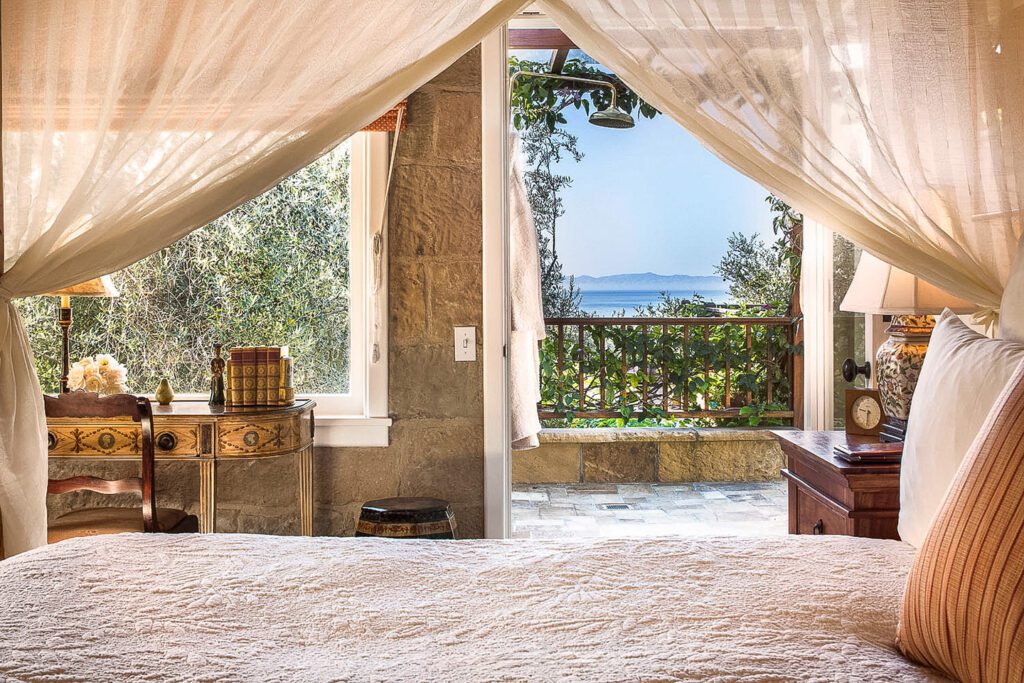
Ocean views from the canopy bed of the Kennedy Cottage at San Ysidro Ranch
Kennedy Cottage at San Ysidro Ranch

San Ysidro Ranch

Opened in 1893 on a former citrus ranch in the foothills of the Santa Ynez Mountains, San Ysidro Ranch has welcomed travelers for more than 130 years. The property’s roots stretch back even further. Mission Padres began farming the land in 1825, and a sandstone packing house built in 1889 survives today as the celebrated Stonehouse restaurant. During the Great Depression, actor Ronald Colman and former senator Alvin Weingand transformed the ranch into an exclusive retreat, beginning its long association with Hollywood and high society. Over the years, Winston Churchill, Audrey Hepburn, and countless luminaries sought refuge here, while John and Jacqueline Kennedy famously honeymooned in what is now known as the Kennedy Cottage. Today, the legendary hideaway remains one of California’s most storied luxury resorts, nestled among 550 acres of gardens, cottages, and coastal vistas.

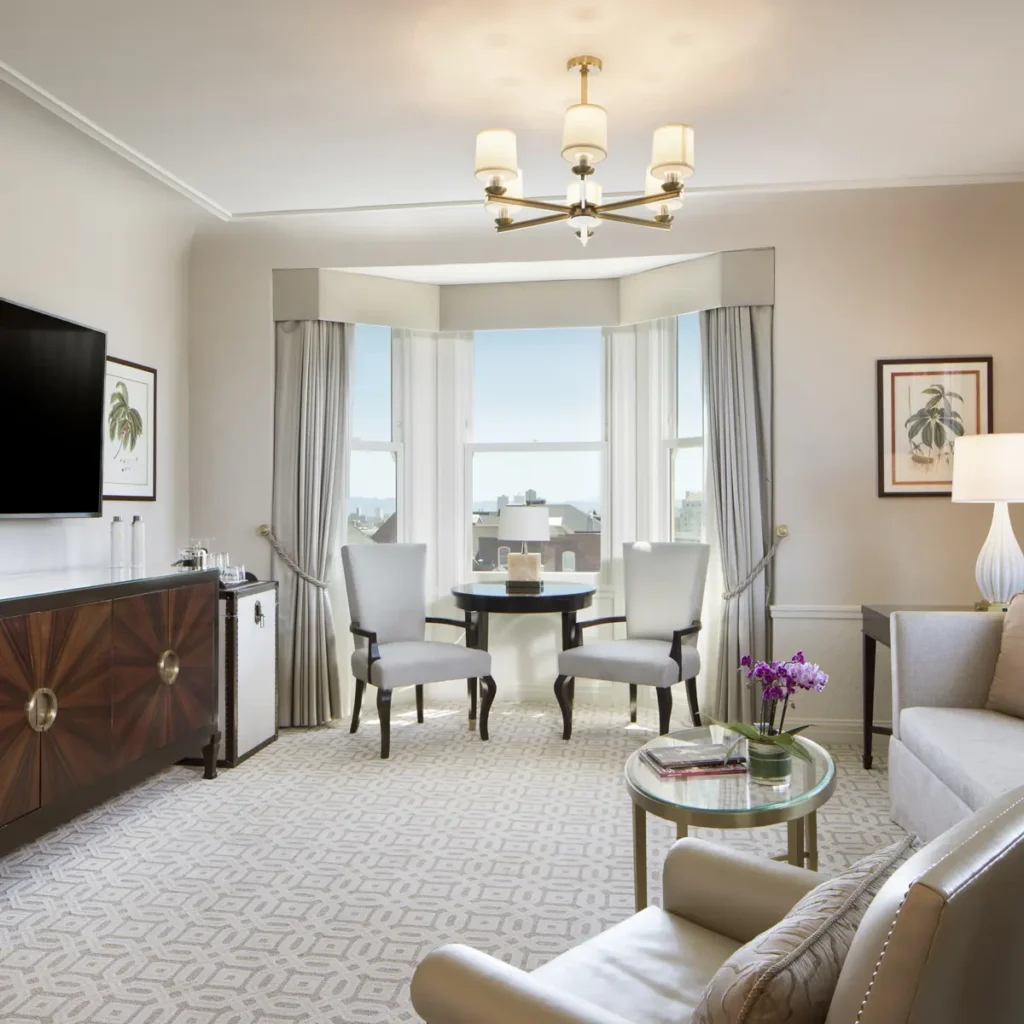
Guest suite at the Hotel Drisco

Hotel Drisco

Built in 1903 as the El Drisco, Hotel Drisco occupies a commanding perch in San Francisco’s prestigious Pacific Heights neighborhood. Originally conceived as a luxury hotel for travelers seeking sweeping views of the city and bay, its future changed dramatically after the 1906 earthquake left thousands homeless. The Edwardian building became a residential hotel, with many guests becoming long-term residents and shared living spaces replacing some of its original luxury accommodations. Decades later, the landmark returned to its hospitality roots, culminating in a meticulous renovation that integrated state-of-the-art systems while restoring its historic grandeur. Today, original architectural details—including hand-carved Honduran mahogany paneling, Ionic columns, grand bay windows, inlaid wood floors, decorative wainscoting, and the original brass rosette on the front door that inspired the hotel’s logo—preserve the hotel’s early 20th-century elegance while offering modern comforts in one of San Francisco’s most coveted neighborhoods. 

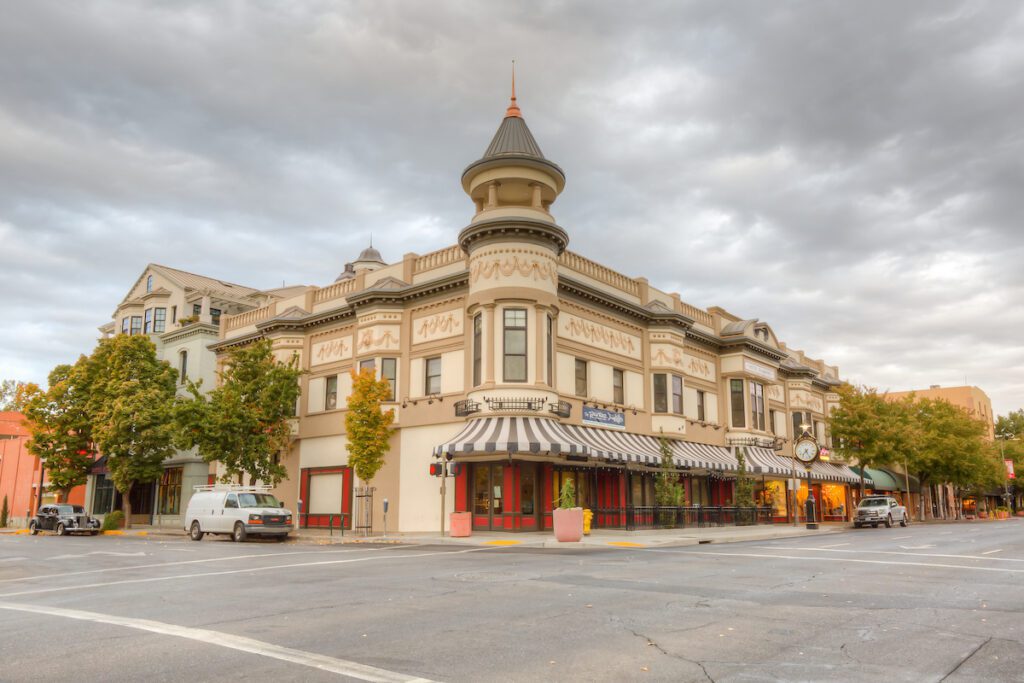
Exterior of the Hotel Diamond

Hotel Diamond

When the Hotel Diamond opened in 1904, it was hailed as Chico’s first “strictly first-class” hotel. The grand three-story property featured steam heat, private baths, gas and electric lighting, a 200-seat dining room, and even one of Chico’s earliest automobiles—a Studebaker wagonette that ferried guests to and from the train depot. For a dozen years, the Diamond stood at the center of the city’s social life until a devastating fire in 1916 extinguished the lights. Over the decades, the building served as a feed store, a women’s dormitory, and various restaurants and bars before falling into abandonment and near ruin. A dedicated local family restored and reopened the landmark in 2005, marking the renewal of a local legacy. Today, guests can still spot original artifacts in the lobby, including a fire-scarred mirror, an antique couch, and a chandelier that connects the restored hotel to its early-20th-century roots.

A guest room of the San Benito House
A guest room of the San Benito House Historic Inn

San Benito House Historic Inn

Built in 1905 as the Hotel Mosconi, the San Benito House Historic Inn is the oldest continuously operating hotel on the San Mateo County Coastside. Located on a prominent corner in downtown Half Moon Bay, the hotel has welcomed generations of travelers, including stagecoach drivers who traveled the coastal route long before modern highways connected the region. Its roots stretch back even further to the late 1800s, when Spanish immigrant Estanislao Zaballa established a saloon and general store on the site, creating one of the coast’s earliest commercial gathering places. As the town evolved from an agricultural settlement into a popular seaside destination, the landmark remained a gathering place for locals and visitors alike. Today, the beautifully restored inn preserves its Victorian-era character while offering modern comforts just steps from Half Moon Bay’s shops, restaurants, beaches, and coastal trails.

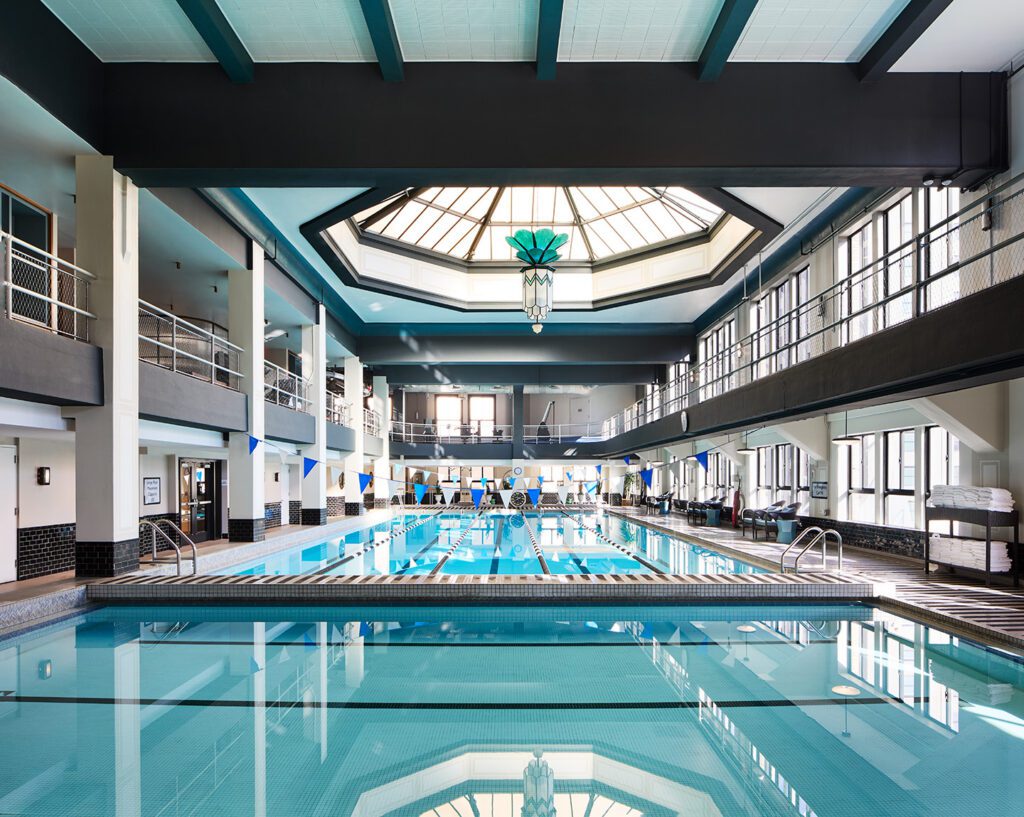
The Los Angeles Athletic Club pool

The Los Angeles Athletic Club Hotel

Founded in 1880 and housed in its iconic Beaux Arts building since 1912, The Los Angeles Athletic Club is the city’s oldest private members’ club and one of downtown L.A.’s most enduring landmarks. Designed by renowned architects John Parkinson and George Bergstrom, the 12-story clubhouse became a gathering place for athletes, entertainers, and business leaders who helped shape modern Los Angeles, including Charlie Chaplin, Mary Pickford, and Olympic champion Johnny Weissmuller. Overnight guest rooms offered exclusive stays for visiting members and their guests, while its celebrated sixth-floor swimming pool—believed to be the oldest elevated pool in Southern California—welcomed generations of athletes beneath a soaring skylight and an elegant chandelier. Today, overnight guests enjoy access to the storied club’s athletic facilities, restaurants, lounges, and collections of memorabilia, offering an immersive glimpse into more than a century of Los Angeles history.

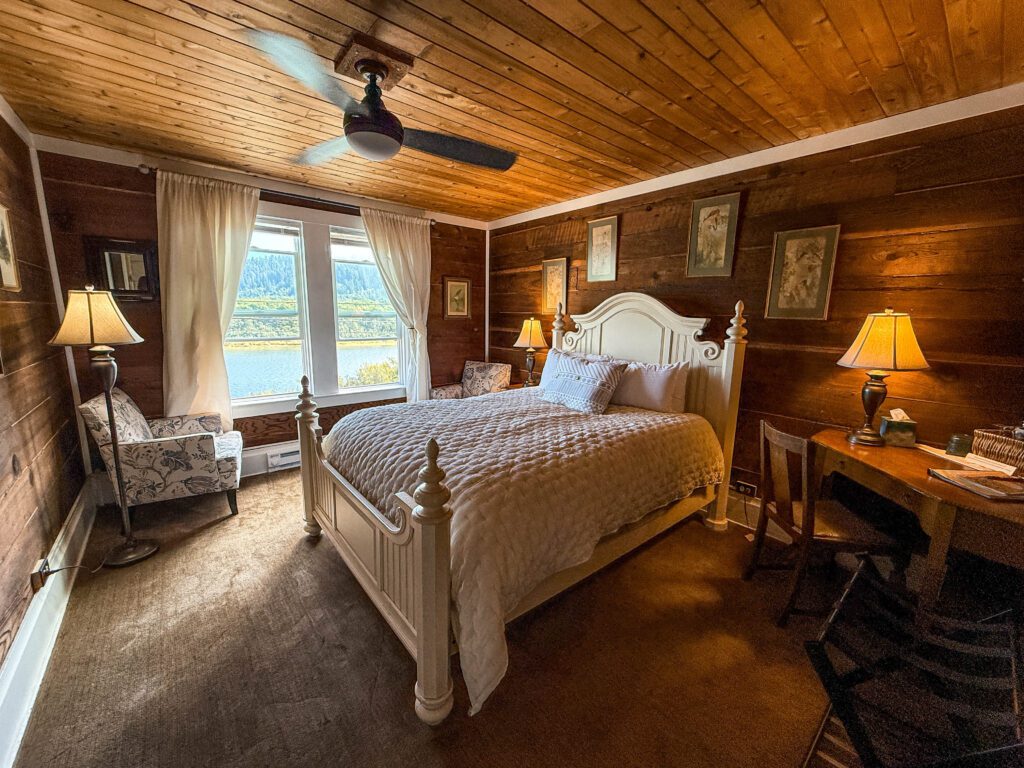
Emerald Ridge Room with exposed original redwood wall construction at the Historic Requa Inn

Historic Requa Inn

Built in 1914 after the original hotel was destroyed by fire, the Historic Requa Inn rose alongside the booming commercial salmon-fishing industry at the mouth of the Klamath River. Perched above the river on Yurok ancestral land, the Arts and Crafts-era inn welcomed fishermen, travelers, and workers drawn to one of California’s most remote and rugged frontiers. As the fishing industry declined, the landmark endured shifting fortunes and ownership before being restored by the family of a Yurok Tribal Elder, bringing the property’s story full circle. Today, guests can still browse historic photographs, scrapbooks, and an original guest register, while the inn’s original redwood walls and artifacts preserve a tangible connection to more than a century of North Coast history.

McCloud Hotel
McCloud Hotel

McCloud Hotel

Built in 1916, the McCloud Hotel originally housed single men working for the McCloud River Lumber Company. The company’s large lumber mill operations helped make McCloud one of California’s most successful company towns. At the height of the lumber boom, the company owned nearly everything in town, from the hotel and mercantile to the homes where employees lived. Although many company towns disappeared as their industries declined, McCloud retained much of its historic character following its privatization in 1963. Today, the beautifully restored Arts-and-Crafts hotel showcases original architectural details, including a wood-burning fireplace flanked by built-in bookcases, box-beam ceilings, and the original registration desk, offering guests a glimpse into California’s bygone lumber days at the base of Mount Shasta.

The pool at El Encanto

El Encanto

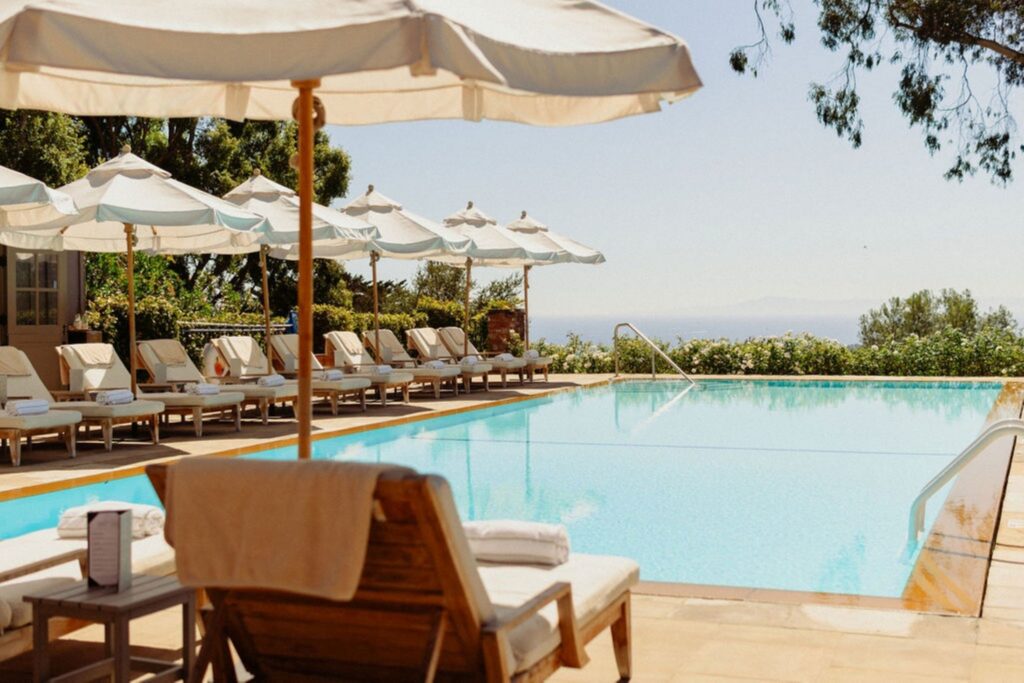
Perched high in the foothills above Santa Barbara, El Encanto opened in 1918 as a collection of California Craftsman-style cottages overlooking the Pacific Ocean and the Channel Islands. As Santa Barbara embraced its signature Spanish Colonial Revival aesthetic in the 1920s, the hotel expanded with elegant new bungalows featuring terracotta roofs, arched doorways, and wrought-iron details. The secluded hillside retreat soon became a favorite escape for Hollywood luminaries, including Clark Gable, Carole Lombard, and Hedy Lamarr. In 2004, El Encanto underwent a meticulous seven-year, $134 million restoration to preserve its historic cottages and gardens while introducing modern five-star luxury. Today, the storied resort continues to welcome guests with lush landscaping, enchanting ocean views, and timeless Santa Barbara charm.

Granada Hotel & Bistro

Granada Hotel & Bistro

Built in 1922, the Granada Hotel & Bistro was originally designed as a hospital, complete with wide hallways to accommodate gurneys. But plans changed before construction was complete, and the building opened as a hotel beside San Luis Obispo’s popular Elmo Theatre. It became a gathering place for traveling performers, artists, and visitors during the Jazz Age. After decades as a hotel, followed by stints as residential housing and other businesses, the historic building was slated for demolition in 2010. Instead, a late-night conversation among four friends at Burning Man led to an ambitious plan to save the landmark and restore it to its original purpose. Reopened in 2012, the 17-room boutique hotel reflects a deeply personal vision, with carefully curated antiques, commissioned artwork, rich textiles, original hardwood floors, exposed brick walls, and even a hand-selected collection of books and music that breathe new life into one of downtown San Luis Obispo’s most distinctive landmarks.

Lobby of The Cardinal Hotel

The Cardinal Hotel

Built in 1924 in the heart of downtown Palo Alto, The Cardinal Hotel is one of the city’s most enduring architectural landmarks. Designed by renowned California architect William H. Weeks in collaboration with local architect Birge Clark, the hotel blends Spanish Colonial Revival styling with classical influences. Guests entering the historic lobby are greeted by original Spanish iron chandeliers, marble columns, hand-painted wooden beams, and carved ram’s heads. A vintage Bell System switchboard and a manually operated elevator offer rare glimpses into a bygone era. Since 1945, the property has been owned and operated by the Dahl family, making it one of the region’s longest-running family-owned hotels. Today, the landmark remains a welcoming centerpiece of Palo Alto’s historic downtown district.

Hotel Santa Barbara lobby
Lobby of the Hotel Santa Barbara

Hotel Santa Barbara

Hotel Santa Barbara traces its heritage to the original Santa Barbara Hotel, which opened in 1876 when the city was still a small pueblo. After the devastating 1925 earthquake destroyed the landmark, civic leaders seized the opportunity to reimagine downtown, embracing the Spanish Colonial Revival architecture that would come to define Santa Barbara’s character. Opened in 1926, Hotel Santa Barbara became part of that transformation, welcoming a new generation of travelers to the heart of State Street. Nearly a century later, a stunning renovation refreshed the landmark for a new generation while preserving signature architectural features, including its ornately carved exterior portico and the lobby’s striking archways and columns. The addition of 1926, a new, elegant lobby bar named for the year the hotel opened, honors the past while carrying forward a hospitality tradition that spans nearly 150 years.

Cottage beneath the pines at Kit Carson Lodge

Kit Carson Lodge

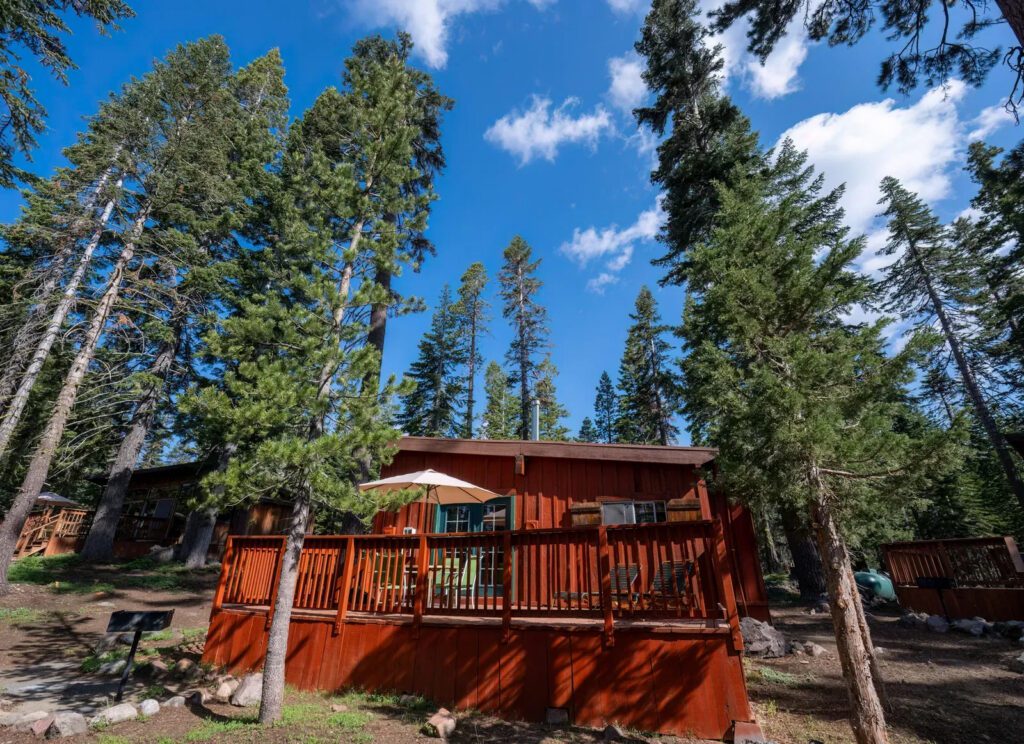
Built in 1926 on the shores of Silver Lake, Kit Carson Lodge has welcomed travelers to California’s High Sierra for 100 years. The rustic mountain retreat sits along the historic Carson Pass and Emigrant Trail, once traveled by Gold Rush-era wagon trains crossing the Sierra Nevada. Established by retired Army officer Captain A.O. Smith and named for famed frontiersman Kit Carson, the lodge became a basecamp for generations of anglers, hikers, and families exploring the surrounding mountains. While much has changed across California’s resort landscape, the lodge has remained true to its roots, with rustic cabins, a relaxed atmosphere, and traditions that have drawn some families back for five generations. Today, it remains one of the Sierra’s most enduring mountain retreats.

A suite at the Inn at the Opera

Inn at the Opera

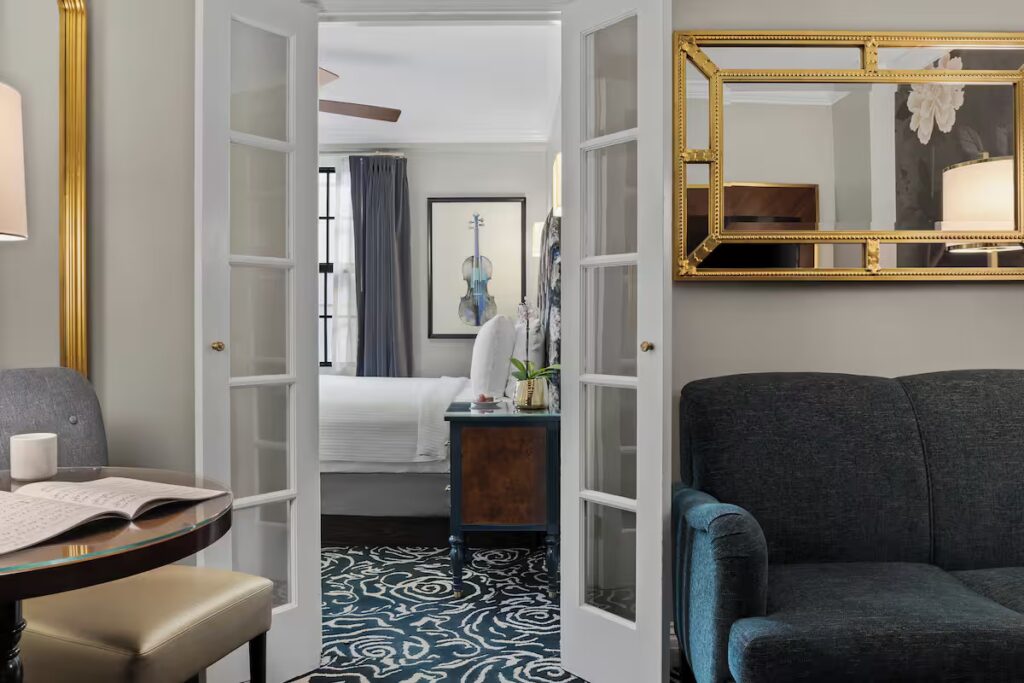
Located directly across from San Francisco’s War Memorial Opera House, the Inn at the Opera is deeply intertwined with the city’s performing arts heritage. Originally built as a residential-style property during the development of the Civic Center, the intimate building reflects an era when visiting artists, patrons, and affluent travelers sought extended stays near the city’s cultural institutions. As the San Francisco Opera and Ballet rose to international prominence, the neighborhood became synonymous with the arts, and the inn evolved into a welcoming retreat for performers and audiences alike. Today, thoughtfully refreshed interiors, European-inspired décor, and theatrical touches celebrate the property’s enduring connection to opera, music, and performance while preserving the charm of a classic boutique hotel in the heart of San Francisco’s cultural district.

10 Snowy Winter Escapes in California

Plan an escape to California’s winter wonderlands this season to swish down ski slopes, snowshoe through the wilderness, or glide through the snow on a pair of cross-country skis. Afterwards, bask in the warmth of a nearby boutique hotel with a roaring fire, a steaming cup of cocoa, luxe amenities, and unique personal touches. Here’s a list of California retreats that are ideal for snowy winter adventures and relaxation. 

Fireplace at Black Bear Lodge

Black Bear Lodge

In South Lake Tahoe and minutes from world-class skiing, Black Bear Lodge combines rustic alpine style with a modern, upscale vibe. A 32-foot river rock fireplace anchors the main lodge’s soaring great room, which features exposed wood beams and a wall of windows for watching the snowflakes swirl outside. A ski shuttle for Heavenly Mountain Resort stops just outside the front door, providing easy access to the lifts and breathtaking views of Lake Tahoe. Snowshoe and cross-country trails, sledding hills, and horse-drawn sleigh rides are also nearby. After a day of adventure in the snow, cozy up to the fire with a glass of wine or soak in the gazebo-covered outdoor hot tub.

Cottage Inn at Lake Tahoe in winter
Cottage Inn at Lake Tahoe

Cottage Inn at Lake Tahoe

Tucked among towering pines on Lake Tahoe’s quiet western shore, the Cottage Inn at Lake Tahoe features a cluster of cozy vintage cottages with enchanting, woodsy décor. Built in “Old Tahoe” style in 1938, each cottage is uniquely themed, but all feature warm, knotty-pine paneling, stone accents, inviting fireplaces, and thoughtfully designed baths. Some cottages also offer soaking tubs for two. Just steps from the lake, guests can stroll the shore along a private beach and enjoy the panoramic views of snow-covered mountains. Nearby, several downhill and cross-country ski resorts await, including Lake Tahoe’s largest resort: Palisades Tahoe. After the day’s adventure, guests enjoy mulled wine and hors d’oeuvres beside a crackling fire in the main lodge.

Guest room at Donner Lake Inn

Donner Lake Inn

Near historic Truckee, the Donner Lake Inn is nestled on two forested acres just steps from Donner Lake. The small, family-friendly lodge offers five comfortable guest rooms with private entrances, cozy gas stoves, and bunk beds for the kids. The lodge is close to several downhill and cross-country ski areas. Sugar Bowl Resort is just five miles away. Palisades Tahoe, Northstar California Resort, and Royal Gorge Cross Country are all within a 20-minute drive. Back at the inn, a creek-side hot tub provides a relaxing soak beneath the stars and towering pines. The next morning, guests can fuel up for a day on the slopes or the trail with a complimentary grab-and-go breakfast. 

One of the cottages at Highlands Ranch Resort

Highlands Ranch Resort

Near the southern entrance to Lassen Volcanic National Park, Highlands Ranch Resort sits on 175 acres at the edge of a bucolic meadow. Seven newly built cottages stand along the meadow’s edge, combining contemporary design with rustic-chic décor and luxe amenities. Guests can warm themselves by the fire, enjoy the heated tile floors, cuddle up in dreamy beds, and soak in a private hot tub overlooking the meadow. An upscale lodge anchors the resort with a full-service restaurant and bar. In the winter months, cross-country skiers glide across the snow while others cozy up to the outdoor fire pit with views of Lassen’s snow-capped peaks. The resort is also just minutes from backcountry skiing and snowmobile trails.

McCloud Hotel exterior in winter
McCloud Hotel in winter

McCloud Hotel

Built in 1915, the Arts and Crafts-style McCloud Hotel pays homage to McCloud’s bygone days as a lumber mill town. The town lies at the base of Mount Shasta’s southern slope, and while every season has its charms, the winters in McCloud are magical. Snowshoe to waterfalls along the McCloud River. Skate along the groomed cross-country trails at Mt. Shasta Nordic Center. Ski or snowboard down the slopes at Mt. Shasta Ski Park. Discover over 250 miles of snowmobile trails traversing the Modoc, Shasta Trinity, and Klamath National Forests. After a day’s adventure, enjoy a chef-prepared dinner at Sage and curl up in front of the fire in the hotel’s inviting lobby to watch the snowflakes swirl outside. 

Shasta Wintu Suite at the McCloud Mercantile Hotel

McCloud Mercantile Hotel

Just down the street, the McCloud Mercantile Hotel is housed in McCloud’s original 1895 mercantile and features a stylish selection of guest rooms to suit every budget. Each room is inspired by a unique aspect of the region’s history and combines fascinating period-specific details with modern creature comforts. No matter which room you choose, you’ll enjoy heated bathroom floors, down comforters, and luxe amenities. Many rooms also offer fireplaces and whirlpool or clawfoot tubs. The hotel is just minutes from Mt. Shasta Ski Park, Shasta Nordic Center, sledding hills, and miles of trails for snowshoeing and snowmobiling. The hotel also offers several winter packages, including one for Christmas tree cutting.

Exterior of the McCloud River Bed & Breakfast in winter

McCloud River Bed & Breakfast

A short walk from McCloud’s main street, the McCloud River Bed & Breakfast is an intimate, country inn nestled on five acres. Built in 1903 by the McCloud River Lumber Company, the historic building once housed the lumber company’s bank, offices, and telephone switchboard. Beautifully restored, each space was transformed into a unique guest room inspired by its history with cozy furnishings and modern amenities. Guests wake to a gourmet breakfast and delicious made-from-scratch pastries each morning. Dinner is also available with advance reservations. The inn is just minutes from Mt. Shasta’s winter wonderland adventures, including skiing, snowboarding, snowmobiling, and more.

Mocha Room at the McCaffrey House

McCaffrey House Bed & Breakfast Inn

Tucked into the forested slopes of the Sierra Nevada, the McCaffrey House Bed & Breakfast Inn offers easy access to winter adventures. Ski or snowboard at Dodge Ridge Ski Resort. Slide down the hills in an inner tube at Leland Snowplay. Go ice skating at Long Barn Lodge Ice Rink. The inn’s location is also within an easy drive of Yosemite National Park. The charming, three-story inn is nestled in a quiet forest hollow near Twain Harte. Guest rooms feature cozy fire stoves and views of the towering pines. In the evenings, gather in the living room for the fireside wine reception. Each morning, wake to a made-from-scratch breakfast accompanied by forest views, and if the timing is right, snowflakes swirling outside.

Downieville River Inn

Downieville River Inn & Resort

Nestled along the North Fork of the Yuba River in the quiet, historic gold rush town of Downieville, Downieville River Inn & Resort offers a cozy home-away-from-home for winter recreation in the Tahoe National Forest. Each of the charming cottages and guest rooms features a well-stocked kitchen or kitchenette. Most of the rooms have porches or balconies overlooking the river. The on-site sauna is the perfect way to warm up after adventures in the snow. The resort’s location provides easy access to the miles of cross-country skiing, snowshoeing, and snowmobile trails that traverse the Sierra. The resort hosts are happy to serve as your guide.

Historic California Landmarks Reinvented as Boutique Hotels

Some boutique hotels come with more than style and service—they come with stories. Across California, a surprising number of stays began as something entirely different: a lighthouse guiding ships to shore, a courthouse annex, even a 1950s auto repair garage. These buildings have lived whole other lives before being reborn as one-of-a-kind escapes for travelers. Today, their pasts whisper through preserved architecture, clever design nods, and the occasional ghost of their former purpose. 

The exterior of The Butler Hotel

The Butler Hotel

A sophisticated industrial-chic retreat in San Luis Obispo, The Butler Hotel was once a 1950s auto repair garage. The vintage metal and steel prefab structure had sat abandoned for years when a local architect saw its potential hidden beneath the overgrown ivy. Repurposed into a boutique hotel, the property still sports weathered steel panels and polished concrete floors that reveal the patina of age. However, once inside, the industrial façade gives way to an unexpectedly upscale experience featuring mid-century modern design elements, a vinyl library lounge, and a curated collection of art. The hotel also offers modern tech features like self-check-in and virtual concierge services.

The Darling Hotel lobby

The Darling Hotel

The Darling Hotel’s elegantly restored Art Deco building once served justice, not rooftop cocktails. Built in 1935 as the Tulare County courthouse annex, the stunning building was part of Visalia’s old courthouse square. An earthquake destroyed the courthouse in 1952, but the surviving annex remained in use until 2008. A decade later, local investors restored the building to its former grandeur and opened it as a boutique hotel steeped in Art Deco style. Most of the original woodwork and architecture was preserved, including the lobby’s high ceilings and terrazzo floors. The former board chambers are now suites featuring original mahogany doors and built-in alcoves, while a new rooftop restaurant and heated pool infuse the storied property with modern luxury.

East Brother Light Station at sunset

East Brother Light Station

Perched on a rocky islet in San Francisco Bay, East Brother Light Station has guided mariners since 1874 and remains one of California’s last Victorian lighthouses. The lighthouse was slated for demolition in the 1960s, but the Contra Costa Shoreline Parks Committee stepped in to secure recognition for the lighthouse on the National Register of Historic Places. In 1980, a non-profit organization restored the lighthouse and opened it as a bed and breakfast inn. For over 40 years, guests have arrived by boat to be carried back in time, regaled by stories of the lighthouse’s fabled past, and treated to extraordinary meals. Revenues from the inn keep the lights on and ensure the lighthouse’s ongoing restoration and maintenance.

Guest room aboard the Delta King Hotel

Delta King Hotel

In the 1920s, the Delta King once ferried passengers nightly on the 10-hour cruise between San Francisco and Sacramento. During its heyday, the riverboat’s paddlewheel turned to the beat of jazz bands as patrons reveled in prohibition-era drinking, gambling, and fine dining. During World War II, the Delta King was drafted into the U.S. Navy to serve as a naval barracks and hospital ship in San Francisco Bay. Now moored along the Old Sacramento waterfront, the meticulously restored woodwork and Art Deco details evoke the ship’s glamorous cruising days while two restaurants and a bar bring a lively energy to its decks. Renovated staterooms feature period touches along with upscale amenities and riverside views. Guests enjoy a voyage through time that never leaves the dock.

Lodge at the Presidio
Lodge at the Presidio, photo by Ben Davidson

Presidio Lodging

Within the historic Presidio in San Francisco, two hotels share a rich military past. The Lodge at the Presidio was a former U.S. Army barracks that housed soldiers, while the nearby Inn at the Presidio served as the Bachelor Officers’ Quarters. Both hotels preserve their red-brick facades, but inside, the buildings were reimagined as luxurious, contemporary boutique hotels that honor their military history with inspired design. The Lodge at the Presidio’s original mess hall is now an elegant dining room. The Inn at the Presidio’s suites exude the understated luxury and comfort once reserved for Army officers. Both hotels feature broad porches lined with rocking chairs and a rich array of modern comforts that evoke life “at ease.”

Mother McCloud Suite at the McCloud River B&B

McCloud River Bed & Breakfast

In a former lumber town near Mt. Shasta, a historic building that once housed the lumber company’s bank, offices, and telephone switchboard is now home to the McCloud River Bed & Breakfast. Built in 1903 by the McCloud River Lumber Company, the building was a hub of town life where workers cashed paychecks and managers planned timber harvests. Beautifully restored and renovated, the McCloud River B&B turned each of the spaces into rooms inspired by their history. The switchboard operator’s office became the Switchboard Room, the complaint department became the Mother McCloud Suite, and the former bank vault was transformed into a unique private dining space.

Water Tower cottage at Inn at Schoolhouse Creek

Inn at Schoolhouse Creek

Nestled on a rise above the Mendocino Coast, the Inn at Schoolhouse Creek features several historic cottages. Among the most unique is the Water Tower Cottage. During World War II, the water tower served as a lookout equipped with an anti-aircraft battery for the U.S. Coast Guard. Today, the tower is a prime perch to watch the sunset over the ocean. The base of the tower holds a private hot tub, while a spiral staircase leads to a platform with breathtaking views. Through various eras, the inn’s other historic cottages housed mill workers, military officers, and wandering musicians. Today, they welcome guests with ocean breezes, lush gardens, and a rich history.

The lobby and parlor of the Queen Anne Hotel

The Queen Anne Hotel

Built in 1890 as Miss Mary Lake’s School for Girls, The Queen Anne Hotel retains its genteel Victorian grace. Nestled on the edge of San Francisco’s Pacific Heights neighborhood, the grand Victorian was meticulously restored and transformed into a boutique hotel in the 1980s. Upon entering through the etched glass doors, the hotel transports guests to a bygone era with ornate interiors and exquisite antiques. A grand staircase leads to 48 elegant guest rooms, including the popular Mary Lake Suite, which was once the office of the school’s headmistress. Many of the rooms feature wood-burning fireplaces and floor-to-ceiling bay windows. In keeping with the period charm and traditions, the hotel serves afternoon tea and sherry in the parlor each day.

Pool suite at Downtown LA. Proper Hotel
Pool suite at Downtown L.A. Proper Hotel

Downtown L.A. Proper Hotel

Originally built in 1926 as a private athletic club, the Downtown L.A. Proper Hotel was reimagined as a modern boutique hotel in 2021. The creative vision of designer Kelly Wearstler masterfully blends the building’s period architectural elements—including its athletic facilities—with a soulful mix of Mexican modernism and other design influences. The Basketball Suite reimagines the building’s original basketball court as a dramatic, luxury suite with double-height ceilings featuring a basketball hoop. The spacious, one-of-a-kind Pool Suite was built around the original indoor swimming pool and features a stunning ceramic tile mural.

22 California State Parks to Inspire Wonder

California’s State Parks are a treasure trove of natural beauty, rich history, and outdoor adventure. From ancient redwood groves to sun-drenched coastlines, and alpine lakes to granite spires, each park offers its own sense of place and wonder. This year, discover trails that wind through California’s history, beaches that hush the mind, and vistas that rearrange your sense of scale. Whether you’re chasing solitude or shared discovery, these handpicked parks promise to be unforgettable.

Golden Gate bridge as seen from Angel Island, California
View of Golden Gate Bridge from Angel Island State Park

Angel Island State Park

A short 10-minute ferry ride from Tiburon leads to Angel Island with 360-degree views of San Francisco Bay, the city skyline, and the Golden Gate Bridge. Hike or bike the Perimeter Road or climb to Mount Livermore for sweeping vistas. Explore historic sites including a former U.S. Immigration Station and several military installations. With picnic areas and peaceful coves, it’s a day trip that blends nature and history.

WHERE TO STAY

In Tiburon, you couldn’t stay any closer to the water than the Waters Edge Hotel.  This upscale, coastal-inspired boutique hotel juts out over the harbor providing glittering panoramas of San Francisco Bay and the city skyline. 

Elephant Seals at Año Nuevo State Beach, California, north of Santa Cruz. many of the babies were born within the last week. The males were breeding and fighting.
Elephant Seals at Año Nuevo State Park

Año Nuevo State Park

This coastal park is best known for its elephant seals, which come ashore by the thousands each winter to breed and give birth. Through the winter months, guided walks lead visitors safely through dunes to see the massive animals up close. Outside of seal season, the park’s windswept cliffs, tide pools, and coastal terraces offer stunning hikes and ocean views. Año Nuevo Point is a fantastic birding site along a major bird migratory route. Just offshore, Año Nuevo Island features the remains of a 19th-century lighthouse which is now home to cormorants and sea lions. 

WHERE TO STAY

About 10 miles from the park on Highway 1, the Davenport Roadhouse Inn offers a laid-back coastal retreat with nine newly renovated guest rooms, each decorated with a modern nautical flair and accented with local artwork and historic photographs. Many of the rooms offer ocean views.

Beniamino Bufano’s Peace Obelisk at Timber Cove Resort

Beniamino Bufano’s Peace Obelisk

Rising above the rugged cliffs on the Sonoma coast, a 93-foot obelisk anchors California’s second-smallest state park—a 60-foot circular site overlooking the Pacific. Pacifist sculptor Beniamino Bufano began creating the obelisk as a monument to peace just weeks before the Cuban Missile Crisis. Countering its missile-influenced shape, the sculpture features motifs of the Madonna and child topped by an open, welcoming hand. The sculpture was the largest of Bufano’s work and took seven years to complete. The obelisk is accessible via a short trail at Timber Cove Resort.

WHERE TO STAY

Fully renovated in 2016, the iconic Timber Cove Resort retains the architecture and authenticity of the original midcentury resort while bestowing the comforts and amenities of a modern boutique hotel. The hotel is also just minutes from Salt Point State Park and Fort Ross State Historic Park.

Middle aged woman embracing the base of the trunk of a giant tree, Sequoiadendron giganteum, at Calaveras Big Trees State Park, to provide a scale for size comparisson
Calaveras Big Trees State Park

Calaveras Big Trees State Park

In the Sierra Foothills, this state park showcases some of the largest stands of giant sequoias outside of Yosemite. The North Grove trail is an easy, interpretive walk with famous trees like the Empire State and Mother of the Forest. For solitude, head to the South Grove where longer trails lead to some of the largest trees in the park. Both groves feature awe-inspiring trees that command quiet admiration.

WHERE TO STAY

In downtown Murphys, the Dunbar House is an Italianate-style estate with old-world appeal. Also downtown, The Victoria Inn exudes European charm with elegant décor, fireplaces, and clawfoot tubs. 

The towering granite spires of Castle Crags State Park
The granite spires of Castle Crags State Park

Castle Crags State Park

Inspiring legends, the 6,000-foot-tall Castle Crags tower above an alpine forest in Northern California. The Crags Trail climbs to a jaw-dropping vista point with views of Mount Shasta and the jagged granite spires that give the park its name. Many more trails ranging from easy strolls to challenging adventures (including the Pacific Crest Trail) pass alongside creeks and through alpine forests to dramatic viewpoints. The Sacramento River flows through the park and offers several access points for fishing and hiking as well.

WHERE TO STAY

The historic McCloud River Bed & Breakfast is a country Victorian Inn set on five serene acres of lawns and woodlands. Each of the 12 stylish guest rooms at the McCloud Mercantile Hotel is inspired by an aspect of the region’s rich history. The meticulously restored, Art and Crafts-style McCloud Hotel Bed & Breakfast features two restaurants and 16 handsome guest rooms.

Stagecoach at Columbia State Historic Park, courtesy of Visit Toulumne County

Columbia State Historic Park

Be transported to the Gold Rush era at Columbia State Historic Park. An authentic living history town, the park features well-preserved 1850s buildings, costumed docents, and working blacksmiths. Kids can pan for gold, ride a stagecoach, or enjoy old-fashioned sweets. The walkable downtown is charming, and nearby trails and picnic spots add outdoor appeal. It’s part museum, part time machine, and thoroughly entertaining.

WHERE TO STAY

Nestled in a quiet forest hollow, the McCaffrey House Bed & Breakfast Inn is a charming mountain retreat near Twain Harte. The inn’s delightful guest rooms feature cozy fire stoves and forest views. 

Donner Lake
Donner Lake

Donner Memorial State Park

Set along the edge of Donner Lake, this park combines alpine beauty with poignant history. The Emigrant Trail Museum tells the story of the ill-fated Donner Party and the westward pioneers. Outside, trails wind through forests of fir and pine, and in summer, the lake is perfect for kayaking, paddleboarding, and swimming. It’s both reflective and recreational—ideal for a mountain escape.

WHERE TO STAY

Donner Lake Inn is a cozy, lodge-style B&B just a three-minute walk from the lake. The inn offers a complimentary grab-and-go breakfast to fuel the day’s adventures and an outdoor hot tub for unwinding beneath the forest at night. 

Emerald Bay at Lake Tahoe

Emerald Bay State Park

Tucked into Lake Tahoe’s southwest corner, Emerald Bay is a showstopper. Its vivid blue-green waters encircle Fannette Island—the lake’s only island—and the Scandinavian-style Vikingsholm Castle offers a peek into 1920s Tahoe elegance. Hike in from the Eagle Falls trailhead or arrive by kayak for the best views. Summer brings vibrant wildflowers and warm water for paddling and swimming.

WHERE TO STAY

On Lake Tahoe’s quiet western shore, The Cottage Inn offers enchanting cottages tucked beneath the pines with access to a private beach. A short walk from the marina in South Lake Tahoe, Black Bear Lodge cabins and lodge-style accommodations offer a well-curated mix of modern and rustic-chic furnishings.

Path with towering trees at Henry Cowell Redwoods State Park
Henry Cowell Redwoods State Park, photo by Daniel Gorostieta courtesy of Visit Santa Cruz County

Henry Cowell Redwoods State Park

Just outside of Santa Cruz, Henry Cowell offers a classic redwood experience with an easy-to-navigate grove trail winding past trees over 1,500 years old. The Redwood Grove Loop is a serene introduction to these giants, while trails like the River Trail or Observation Deck reward hikers with peaceful river views and panoramic scenery. Next door, Roaring Camp Railroads offers vintage steam-train excursions through old-growth forests.

WHERE TO STAY

Between downtown and the beach, the eco-friendly Pacific Blue Inn offers complimentary cruiser bikes and a secluded courtyard with fire pits. On a bluff overlooking the beach, the elegant West Cliff Inn is a beautifully renovated Victorian featuring breezy, coastal-inspired décor. Perched on a cliff directly above the beach, the Sea & Sand Inn offers warm hospitality and exceptional ocean views from every room.

Giant redwood trees along Avenue of the Giants
Avenue of the Giants in Humboldt Redwoods State Park

Humboldt Redwoods State Park

Drive the legendary Avenue of the Giants and step into a forest where trees soar over 300 feet. This massive, 53,000-acre park contains the world’s largest remaining contiguous old-growth redwood forest. Trails like the Founders Grove and Rockefeller Loop showcase towering redwoods and fern-lined creeks. With over 100 miles of trails, it’s a dream for hikers and solitude seekers.

WHERE TO STAY

The landmark Gingerbread Mansion Inn exudes Victorian elegance. Guestrooms are uniquely styled, and most feature a fireplace and clawfoot soaking tub. Built in 1890, the Victorian Inn is a stunning display of craftsmanship with a romantic touch.

Wooden boardwalks and view point at MacKerricher State Park

MacKerricher State Park

Stretching along the Mendocino coast near Fort Bragg, MacKerricher offers a mix of windswept bluffs and beaches, sheltered lagoons, and rich wildlife. Explore tide pools, spot harbor seals near Laguna Point, or follow the former logging route of the Haul Road Trail for an easy coastal ride or stroll. Glass Beach, just to the south, is a popular stop, but MacKerricher itself offers more space, fewer crowds, and miles of windswept beauty.

WHERE TO STAY

In Fort Bragg, the historic Noyo Harbor Inn is a beautifully restored Craftsman rising above the Noyo River with a private path down to the harbor. The Inn at Newport Ranch’s remote, 2,200-acre setting feels like an unexplored frontier with 20 miles of trails that meander along oceanfront bluffs and climb through the hills to panoramic vistas.

Man standing in front of a large waterfall
Burney Falls

McArthur Burney Falls Memorial State Park

Teddy Roosevelt called Burney Falls the “eighth wonder of the world.” Watching the 129 feet of cold, rushing water cascade over moss-covered rock is truly awe-inspiring and mesmerizing. Fed by underground springs, the falls flow year-round, creating a cool mist and constant roar. The loop trail offers multiple viewpoints, and nearby Lake Britton adds fishing, swimming, and kayaking to the mix. It’s a refreshing stop in the summer months but also very popular.

WHERE TO STAY

The historic McCloud River Bed & Breakfast is a country Victorian Inn set on five serene acres of lawns and woodlands. Each of the 12 stylish guest rooms at the McCloud Mercantile Hotel is inspired by an aspect of the region’s rich history. The meticulously restored, Art and Crafts-style McCloud Hotel Bed & Breakfast features two restaurants and 16 handsome guest rooms.

Rugged coastline at Montana De Oro State Park

Montana de Oro State Park

Rugged cliffs, secluded beaches, and golden hills define this Central Coast favorite. The Bluff Trail offers easy access to dramatic ocean views, crashing surf, and wildflower-strewn headlands in spring. For more adventure, hike up Valencia Peak or explore tide pools at Spooner’s Cove. With coastal breezes and wide-open space, it’s a go-to for hikers, bikers, and quiet coastal escapes.

WHERE TO STAY

A short drive inland, the legendary Madonna Inn has attracted road-trippers with themed guest rooms and hot pink décor for over 65 years. Near downtown San Luis Obispo, The Butler Hotel boasts striking industrial design and sophisticated modern details. Also nearby, the charming Apple Farm Inn features elegant accommodations with contemporary country décor.

Morro Rock at sunrise

Morro Bay State Park

Anchored by the iconic Morro Rock, this Central Coast park is a haven for birdwatchers, kayakers, and tide pool explorers. The estuary teems with birds and wildlife, while trails like Black Hill winds through dense stands of Monterey Pine to offer panoramic views of the bay and coastline. The park’s natural history museum adds to the appeal, making it easy to mix nature with a bit of learning. The park also has a café, marina, and an 18-hole public golf course. 

WHERE TO STAY

The Art Deco-inspired Rhapsody in View offers stunning views of the iconic Morro Rock. Each of the thoughtfully appointed guest rooms features private west-facing balconies for a front-row seat to sunsets over the ocean. Stays include a full breakfast served daily.

Views from Mount Tamalpais above the fog

Mount Tamalpais State Park

A Bay Area classic, “Mount Tam” offers sweeping views of the Pacific, Marin Headlands, and even the Sierra on clear days. Trails wind through redwood groves, open grasslands, and foggy ridgelines. The Dipsea and Steep Ravine trails are popular for good reason—mixing lush forests with coastal panoramas. It’s a choose-your-own-adventure park for hikers of all levels.

WHERE TO STAY

In downtown Mill Valley, the Mill Valley Inn is a collection of luxurious accommodations, including two creek-side cottages nestled among towering redwoods. 

The rocky coastline at Point Lobos State Natural Reserve

Point Lobos State Natural Reserve

Craggy coastline, turquoise coves, and coastal trails make Point Lobos one of California’s most breathtaking seascapes. Harbor seals nap on rocky outcrops, sea otters float through kelp beds, and wildflowers bloom along the bluffs in spring. The Cypress Grove and Sea Lion Point trails offer the best views—and a front-row seat to the park’s rich marine life and dramatic geology.

WHERE TO STAY

Stilwell Hotel is a new luxury boutique hotel offering a modern, coastal-inspired oasis in Carmel-by-the-Sea. In the heart of the village, Coachman’s Inn features all-new custom furnishings and a soothing color palette. With a heated swimming pool and a range of room configurations, Hofsas House is one of the most family-friendly hotels in town.

Fern Canyon at Redwood National Park

Prairie Creek Redwoods State Park

This lush wonderland on the Northern California coast blends ancient redwoods with fern-filled canyons and Roosevelt elk grazing in open meadows. One of the park’s primeval highlights is Fern Canyon—a narrow, mossy gorge with dripping green walls famously featured in Jurassic Park. For a broader redwood experience, the Cathedral Trees and James Irvine trails offer quiet, majestic hikes under towering trees.

WHERE TO STAY

North of Prairie Creek Redwoods State Park, Historic Requa Inn is a simple, Art-and-Crafts-era inn standing above the banks of the Klamath River and surrounded by wilderness. The lovely Carter House Inns are an enclave of Victorians perched at the gateway to Eureka’s historic district.

View of the Frederick W. Panhorst Bridge and the cove at Russian Gulch State Park

Russian Gulch State Park

Dramatic coastal scenery meets redwood forest at this Mendocino County gem. A trail along the wildflower-strewn headlands leads to a collapsed sea cave called Devil’s Punchbowl where waves crash and churn. Heading inland, the Fern Canyon Trail rewards hikers with a beautiful, 36-foot waterfall. The park also features an iconic bridge that gracefully rises 100 feet from the bottom of the gulch. Launch a SUP or kayak from the beach below the bridge to explore the cove’s calm waters.

WHERE TO STAY

The Inns of Mendocino is a collection of three stylish inns, each with its own modern coastal vibe. The Seagull Inn Bed & Breakfast is one of Mendocino’s original B&Bs and features delicious breakfasts delivered to the room. Gourmet breakfasts delivered to the room are also the star attraction at the historic Headlands Inn Bed & Breakfast. One of Mendocino’s finest Victorian landmarks, the MacCallum House Inn exudes the romance of a bygone era.

Bowling Ball Beach at Schooner Gulch State Beach

Schooner Gulch State Beach

A short detour off Highway 1 near Point Arena brings you to one of California’s most unique and surreal coastal photo ops. At low tide, the beach reveals smooth, round boulders that resemble oversized bowling balls—a natural phenomenon that gives it the nickname “Bowling Ball Beach.” With its dramatic cliffs, crashing surf, and unique geology, it’s a must-see for photographers and beachcombers alike. The clifftops also provide a stunning perch for watching sunsets. 

WHERE TO STAY

In Point Arena, Wildflower Boutique Motel is a former roadside motel transformed into an eco-friendly getaway with blooming gardens and modern décor. Mar Vista Farm + Cottages is a bucolic hideaway with 10 vintage cottages scattered around a small farm. Guests can harvest vegetables from the gardens and enjoy fresh eggs delivered daily.

Redwoods along Apots Creek in The Forest of Nisene Marks State Park
The Forest of Nisene Marks State Park, photo by Caryn Hewlett courtesy of Visit Santa Cruz County

The Forest of Nisene Marks State Park

Off the beaten path from more well-known beaches and redwood parks near Santa Cruz, Nisene Marks offers a serene escape into a redwood forest in recovery. Once clear-cut by loggers over 100 years ago, this rugged semi-wilderness of second and third-growth redwoods rises from sea level to steep coastal mountains of more than 2,600 feet. 30 miles of hiking, biking, and jogging trails take visitors deep into the forest past logging remnants, trickling streams, and a majestic grove of old-growth trees.

WHERE TO STAY

Built in 1887, Sand Rock Farm is a quiet retreat nestled on 10 acres in Aptos, south of Santa Cruz. Beautifully restored, the inn features a sunny reading porch, a large outdoor deck with a fire pit, and five light-filled suites overlooking the gardens.

Sunrise at Broken Hill at Torrey Pines State Reserve

Torrey Pines State Natural Reserve

Clinging to the cliffs above the Pacific, Torrey Pines is one of only two places on the planet where the nation’s rarest pine tree grows. The park preserves not only the wind-sculpted pines but also one of the last salt marshes and waterfowl refuges in Southern California. The reserve offers an easy urban escape with sweeping ocean views. Hike the Razor Point or Guy Fleming trails for dramatic overlooks and seasonal wildflower displays in spring and early summer.

WHERE TO STAY

Inspired by nature, Twelve Senses Retreat in Encinitas nurtures guests’ well-being with a focus on sustainability. A garden-filled oasis near the beach, every detail of the Inn at Moonlight Beach was designed with wellness in mind. 

Kayaking through sea caves at Van Damme State Park with Kayak Mendocino

Van Damme State Park

Nestled just south of Mendocino, Van Damme offers a rare mix of pygmy forest, fern canyons, and a sheltered beach. Paddle sea caves and watch for marine life in a kayak or hike the Fern Canyon Scenic Trail, where lush greenery thrives beneath towering trees. The unique ecology of the pygmy forest—where ancient trees grow only a few feet tall—is both curious and captivating.

WHERE TO STAY

Next door to Van Damme, the historic Little River Inn offers sweeping ocean views and a popular restaurant and bar. The pet-friendly Cottages at Little River Cove feature fully equipped cottages, ocean views, and beautiful gardens. Revel in the cozy ambiance of Dennen’s Victorian Farmhouse featuring a new tearoom and pet-friendly rooms. Nestled amid the gardens, the Inn at Schoolhouse Creek offers 17 unique, pet-friendly rooms and cottages, many with ocean views.